


Litecoin Halving: History, Supply and the 2027 Outlook
Explore Litecoin's halving heights, subsidy and supply calculations, the estimated 2027 event and the limits of historical price comparisons.
On this page
Litecoin's halving schedule is a rule about newly issued coins. Its historical market effects are an empirical question. Keeping those two ideas separate makes the event easier to understand and harder to turn into an unsupported trading promise.
Reviewed 18 September 2026. This guide explains the issuance mathematics, the estimated 2027 event and how to construct a consistent historical price comparison.
The rule is expressed in blocks
Litecoin's mainnet parameters specify a halving interval of 840,000 blocks and a target block spacing of 150 seconds. The subsidy implementation applies the corresponding reductions.
At the target spacing, one interval is 126,000,000 seconds, approximately 1,458.3 days. That is roughly four years, not an exact calendar period. Actual block arrivals move the estimated date.
| Reduction | Block height | Calendar reference | Subsidy after the change |
|---|---|---|---|
| First | 840,000 | 2015 | 25 LTC |
| Second | 1,680,000 | 2019 | 12.5 LTC |
| Third | 2,520,000 | 2023 | 6.25 LTC |
| Fourth | 3,360,000 | Estimated in 2027 | 3.125 LTC |
The halving countdown is the appropriate place for a changing estimate. A month or day quoted in a static article should not be mistaken for a protocol deadline.
How the cumulative schedule works
Each full early era contains 840,000 subsidies at its applicable rate. Multiplying and adding those eras produces a simple theoretical schedule.
| At the start of the era beginning at height | Scheduled subsidies before that height | Share of the approximate 84m cap |
|---|---|---|
| 840,000 | 42,000,000 LTC | 50% |
| 1,680,000 | 63,000,000 LTC | 75% |
| 2,520,000 | 73,500,000 LTC | 87.5% |
| 3,360,000 | 78,750,000 LTC | 93.75% |
| 4,200,000 | 81,375,000 LTC | 96.875% |
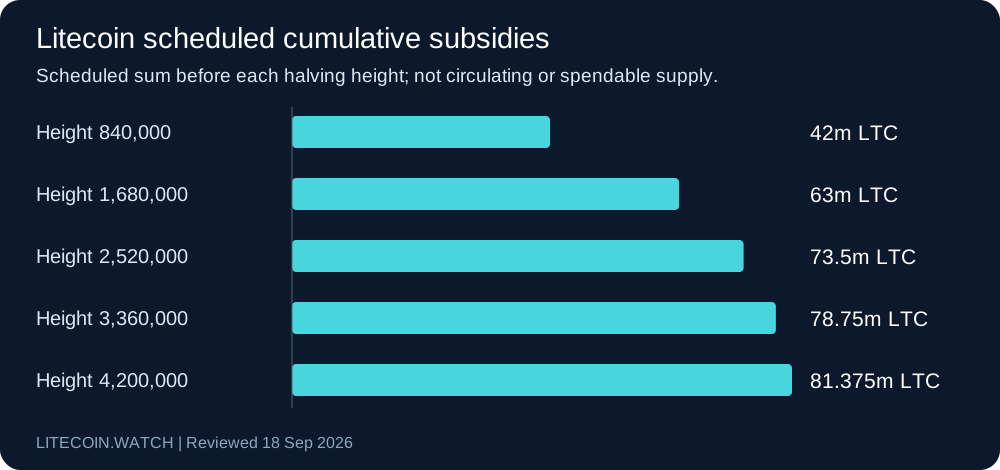
These are scheduled subsidy sums, including the genesis-era convention. They are not measured circulating supply or spendable balances. Unclaimed rewards, unspendable outputs, lost keys and provider definitions create separate accounting questions.
Fees do not create new LTC; they transfer value from transactions to miners. Adding fees to cumulative issuance would count existing coins again.
Later integer rounding at the smallest unit also matters to an exact total. The familiar 84 million cap is a useful rounded description, not evidence that precisely that many spendable coins will eventually be available.
Flow falls while the existing stock remains
At 576 target blocks per day, the next reduction changes scheduled daily issuance from 3,600 to 1,800 LTC. Under a 365-day convention, that is 1,314,000 versus 657,000 LTC annualized.
Holders' existing balances are not halved. Nor does the supply already available for sale vanish. The effect on market supply depends on how miners, existing holders and buyers behave.
Consider an explicitly hypothetical assumption that miners sell half of newly issued LTC. Under unchanged conditions, modeled sales from the subsidy would fall from 1,800 to 900 LTC per day. The assumption is doing substantial work: it is not a measured universal sell-through rate.
Stock-to-flow is a ratio, not a valuation equation
Stock-to-flow divides a selected stock measure by annual new production. Using 78.75 million scheduled LTC and 657,000 LTC of annualized issuance gives approximately 119.9 years.
That number has units: it is the time required to reproduce the selected stock at the assumed annual flow. It is not a price multiple or a probability of appreciation.
Changing the stock definition or annualization changes the result. The ratio also omits demand, liquidity, lost coins, substitute assets and willingness of existing holders to sell. A halving mechanically increases this ratio under fixed assumptions without mechanically determining a dollar price.
Reconstructing historical returns
A usable event study states its price source, quote currency, observation cutoff and return windows. The halving block timestamp and the day's closing price are not necessarily the same moment.
| Choice | Why it matters |
|---|---|
| Single venue or aggregate index | Prices and outages can differ |
| Intraday point or daily close | Changes the measured event price |
| Fixed observation windows | Avoids selecting convenient peaks and troughs |
| USD and BTC benchmarks | Separates absolute from relative performance |
| Trading costs | Distinguishes a chart return from an executable result |
| Missing-data treatment | Prevents silent distortion |
For example, define 90 days before and 90 days after each event before looking at the outcome. Include all three completed events under the same method. Do not use a different rally start for each one and call the resulting average a repeatable strategy.
Three events are also too few to isolate a causal effect confidently from broad market conditions. A narrative about macroeconomic forces should be supported separately rather than treated as proven by the shape of a chart.
Miner economics require both chains and costs
Litecoin subsidy revenue is one component of compatible Scrypt miners' economics. Dogecoin merged-mining proceeds, fees, pool deductions, power and hardware costs can materially change the result.
A hypothetical operation earning $30 from LTC subsidy and $70 from other unchanged mining proceeds would lose $15 of its $100 gross revenue when only that subsidy component halves. Its electricity bill would not automatically fall.
That does not establish a permanent external subsidy or guarantee a security budget. Prices, difficulty, participation and pool policies can change on both networks.
The 2027 mining-impact guide and mining operations guide provide more detailed examples.
What to monitor before 2027
Track block height, dated revenue assumptions and software or service changes. Separate delivered developments from forecasts: LTCC already began Nasdaq trading in October 2025, as documented in the ETF timeline. “If an ETF exists by the halving” is therefore an outdated framing.
Future fund flows, market demand and mining margins remain uncertain. A useful scenario varies those inputs and reports the resulting arithmetic without assigning invented probabilities.
Use the LTC/BTC analysis when studying relative performance. A gain against one benchmark does not necessarily imply a gain in the currency used to pay expenses.
Download the illustrative calculations as CSV.
Frequently asked questions
Is July 2027 a guaranteed date?
No. The next trigger is block 3,360,000; the calendar estimate changes with actual block production.
Does the halving reduce my wallet balance?
No. It changes new subsidy issuance, not existing balances.
Does a higher stock-to-flow ratio prove a higher fair value?
No. It describes stock relative to annual production and does not supply a complete valuation model.
Are three past halvings enough to establish a reliable trading rule?
No. A small sample, changing market conditions and selection of observation windows limit that inference.



Track Litecoin in real time
Rates for 30+ currencies. Check each tool for its latest source timestamp.
Open dashboard