Guide

How to read cryptocurrency exchange rates — a trader's guide

Whether checking LTC price for the first time or evaluating market conditions, understanding rate data is fundamental. This guide breaks down every piece of information on rates tables — from basic bid-ask spreads to advanced order book analysis, candlestick charts, and on-chain sentiment indicators — and shows you how to use each for better trading decisions.

Currency pairs

Rates are always expressed as a pair: LTC/USD, BTC/EUR, LTC/BTC. The first currency is the base (what you are pricing), and the second is the quote (the measuring unit).

LTC/USD = 100 means 1 Litecoin costs 100 US dollars. To find the inverse: 1/100 = 0.01 LTC per dollar. When you see LTC/BTC = 0.0015, it means 1 LTC costs 0.0015 BTC.

Understanding pairs is critical because the same asset can look bullish in one pair and bearish in another. LTC/USD may be rising while LTC/BTC is falling — meaning Litecoin is gaining value against the dollar but losing ground relative to Bitcoin. Experienced traders monitor multiple pairs simultaneously to get the full picture.

Bid, ask, and spread

TermDefinitionWhen you see itExample (LTC/USD)
BidHighest price buyers will payPrice you get when selling$99.85
AskLowest price sellers acceptPrice you pay when buying$100.05
SpreadAsk minus BidYour implicit trading cost$0.20 (0.20%)
Mid price(Bid + Ask) / 2Fair value reference$99.95

What affects the spread

  • Liquidity: more traders and market makers = tighter spreads. LTC/USD on Coinbase typically has a $0.01-0.05 spread; on a small exchange it might be $0.50+
  • Volatility: fast price moves cause market makers to widen spreads to protect themselves
  • Time of day: tightest during US/EU market overlap (13:00-17:00 UTC); widest during Asian-only hours
  • Exchange tier: major platforms (Coinbase, Kraken, Binance) consistently have tighter spreads than smaller venues
  • Order size: large orders face wider effective spreads because they consume multiple price levels in the order book

Order book depth analysis

The order book is the core data structure of any exchange. It lists every open buy order (bids) and sell order (asks) at each price level, along with the quantity available. Understanding order book depth separates casual price-checkers from informed traders.

How to read an order book

Bid side (buy orders) — typically shown in green:
$99.95 — 150 LTC
$99.90 — 320 LTC
$99.85 — 500 LTC
$99.70 — 1,200 LTC ← buy wall
$99.50 — 200 LTC
Ask side (sell orders) — typically shown in red:
$100.05 — 120 LTC
$100.10 — 280 LTC
$100.20 — 450 LTC
$100.50 — 2,000 LTC ← sell wall
$100.80 — 180 LTC

Key order book concepts

  • Walls: Unusually large orders at a single price level. A buy wall at $99.70 with 1,200 LTC acts as support — significant selling pressure is needed to push the price below it. A sell wall at $100.50 with 2,000 LTC acts as resistance
  • Imbalance: If total bid volume significantly exceeds total ask volume within 2% of the current price, it suggests upward pressure. The reverse signals downward pressure
  • Depth ratio: Calculate bid volume / ask volume within 1-2% of mid price. A ratio above 1.5 is bullish; below 0.67 is bearish. For LTC on major exchanges, a healthy depth ratio is typically between 0.8 and 1.2
  • Spoofing awareness: Large walls can be fake — placed to intimidate traders then cancelled before execution. If a wall appears and vanishes repeatedly, it is likely spoofing. Focus on filled orders (trade history) rather than open orders alone

Market orders vs. limit orders vs. stop orders

The order type you choose fundamentally affects the price you pay and the certainty of execution. Understanding all three is essential for effective trading.

Order typeHow it worksFills atBest forRisk
Market orderExecutes immediately at best available priceCurrent bid (sell) or ask (buy)Small orders, urgent executionSlippage on large orders or thin books
Limit orderExecutes only at your specified price or betterYour price or betterMost situations; price controlMay never fill if price does not reach your level
Stop-loss orderBecomes a market order when price hits your stop levelMarket price after triggerRisk management; protecting profitsCan fill at worse price than stop in fast moves
Stop-limit orderBecomes a limit order when price hits your stop levelYour limit price or betterPrecise risk managementMay not fill if price gaps through your limit
Trailing stopStop level moves with price at a fixed distanceMarket price after triggerLocking in profits on a trendWhipsaws in choppy markets
Pro tip: Always use limit orders for purchases over $500. Set the limit slightly above the current ask price (e.g., $100.10 when ask is $100.05) for near-instant fills with slippage protection. This costs you nothing extra and prevents the rare but painful scenario of a sudden price spike consuming multiple order book levels during your market order.

Slippage: calculation and prevention

Slippage is the difference between the expected price of a trade and the actual execution price. It occurs when your order is large relative to the available liquidity at the best price level.

Slippage calculation example

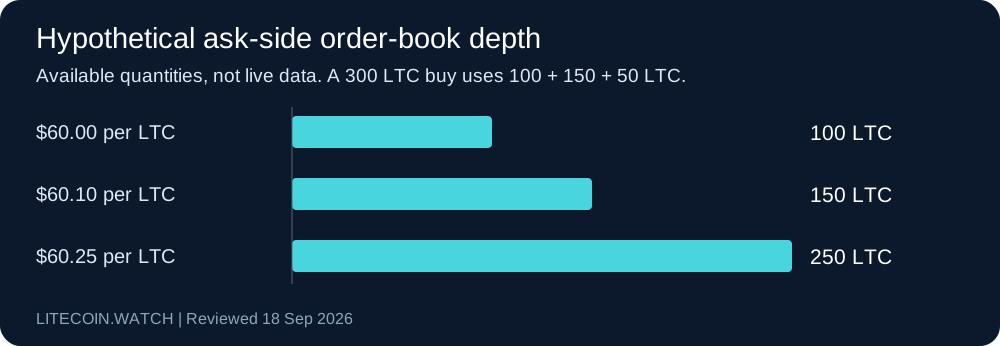
Suppose you want to buy 1,000 LTC with a market order, and the order book looks like this:

Ask priceQuantity availableCumulative LTCCumulative cost
$100.00200 LTC200$20,000
$100.10300 LTC500$50,030
$100.25350 LTC850$85,117
$100.50150 LTC1,000$100,192

Your 1,000 LTC market buy would cost $100,192 total, giving an average price of $100.19. That is $0.19 slippage from the initial ask of $100.00 — a 0.19% cost. On a $100,000 order, that is $190 lost to slippage. With a limit order at $100.25, you would only fill 850 LTC but avoid the worst price level entirely.

Reducing slippage

  • Use limit orders instead of market orders
  • Trade on high-liquidity exchanges (Binance, Coinbase, Kraken for LTC)
  • Split large orders into smaller chunks over time (TWAP strategy)
  • Avoid trading during low-liquidity hours (early Asian session for USD pairs)
  • Check order book depth before placing large orders

Liquidity analysis: evaluating exchange quality

Not all exchanges are equal. Liquidity — the ability to buy or sell without significantly moving the price — varies enormously between venues. Here is how to evaluate exchange liquidity for Litecoin trading.

Key liquidity metrics

MetricWhat it measuresGood benchmark (LTC/USD)
SpreadCost of immediate round-trip tradeUnder $0.10 (0.1%)
2% depthTotal volume within 2% of mid priceOver $500,000 combined
24h volumeTotal traded in 24 hoursOver $10 million
Order countNumber of distinct orders in the bookOver 500 on each side
Fill ratePercentage of limit orders that executeOver 80% for orders at or near market
Warning: Some exchanges inflate volume figures through wash trading (trading with themselves). Always verify liquidity by checking actual order book depth, not just reported volume. If a $10,000 market order would cause more than 0.5% slippage, the exchange has poor real liquidity regardless of what its volume number claims.

Candlestick chart basics: reading OHLC data

Candlestick charts are the standard visualization for price data across all financial markets. Each candle represents a time period and shows four data points.

Anatomy of a candlestick

Bullish candle (close > open):
     |     ← High (upper wick)
   ┌───┐   ← Close (top of green body)
   │███│   ← Body = price range open to close
   └───┘   ← Open (bottom of green body)
     |     ← Low (lower wick)

Bearish candle (close < open):
     |     ← High
   ┌───┐   ← Open (top of red body)
   │███│   ← Body
   └───┘   ← Close (bottom of red body)
     |     ← Low
OHLC componentMeaningWhat it tells you
Open (O)First trade price in the periodWhere sentiment started
High (H)Highest price reachedMaximum buying pressure
Low (L)Lowest price reachedMaximum selling pressure
Close (C)Last trade price in the periodWhere consensus settled — most important

Key candlestick patterns for LTC traders

  • Doji: Open and close nearly equal (tiny body, long wicks). Signals indecision — often appears at trend reversals
  • Hammer: Small body at top, long lower wick. Appears at bottoms — sellers pushed price down but buyers reclaimed it
  • Engulfing: A large candle that completely covers the previous candle. Bullish engulfing (green covers red) signals reversal up; bearish engulfing signals reversal down
  • Morning star / evening star: Three-candle reversal patterns. Morning star (bearish, doji, bullish) at bottoms; evening star at tops

Volume profile analysis

While standard volume bars show total volume per time period, volume profile shows volume distributed by price level. This reveals where the most trading activity occurred, identifying true support and resistance levels based on actual transaction data rather than pattern recognition.

Key volume profile concepts

  • Point of Control (POC): The price level with the highest traded volume. Acts as a magnet — price tends to return to POC. If LTC's POC over the past month is $98, expect that level to serve as both support and resistance
  • Value Area: The price range containing 70% of total traded volume. Trading within the value area is considered fair price; moves outside are potential breakouts or breakdowns
  • High Volume Nodes (HVN): Price levels with above-average volume. These act as strong support/resistance because many traders have positions there
  • Low Volume Nodes (LVN): Price levels with minimal volume. Price moves quickly through these air pockets — useful for identifying potential fast-move zones

Price change metrics

  • Absolute change: raw dollar difference from previous close (+$2.50). Useful for calculating dollar impact on your position
  • Percentage change: same move expressed as a percentage — essential for comparing moves across different assets and time periods
  • Green = up, Red = down — universal color coding across all financial platforms
  • ATH distance: how far the current price is from the all-time high. LTC's ATH was ~$412 in May 2021

Volume analysis

Volume is the total amount traded over a period (usually 24h). It is arguably the single most important confirmation indicator — price moves without volume are unreliable.

  • High volume + price up = strong buying conviction, move likely sustains
  • High volume + price down = strong selling pressure, further downside possible
  • Low volume + price up = weak rally, likely to reverse
  • Low volume + price down = weak selling, may not follow through
  • Volume divergence: price making new highs but volume declining = weakening trend, potential reversal ahead
  • Volume spike: sudden 3-5x average volume often marks climactic moves (capitulation bottoms or blow-off tops)

Cross rates

Calculated indirectly: LTC/PLN = LTC/USD × USD/PLN. Our dashboard calculates 30+ cross rates automatically. The calculator lets you convert between any supported pair.

Cross rates matter because arbitrage opportunities occasionally exist when different exchange pairs imply different cross rates. Professional traders exploit these discrepancies, which is why they rarely persist for more than a few seconds on major platforms.

Market cap and valuation metrics

Market cap = price × circulating supply. While widely used, it has important limitations and companions:

MetricFormulaWhat it reveals
Market capPrice × circulating supplyRelative size vs other cryptos
Fully diluted valuationPrice × max supplyValue if all coins were in circulation
NVT ratioMarket cap / daily on-chain tx volumeValuation relative to actual usage (lower = undervalued)
MVRV ratioMarket cap / realized capWhether holders are in aggregate profit or loss
Volume-to-market-cap24h volume / market capTurnover rate — how actively the asset trades

Funding rates for perpetual futures

Perpetual futures contracts (perps) are the most traded crypto derivative instruments. Unlike traditional futures, perps have no expiration date. Instead, they use a funding rate mechanism to keep the contract price aligned with the spot price.

How funding rates work

  • When the funding rate is positive, long (buy) positions pay short (sell) positions. This means the market is net long — bullish sentiment dominates, and longs pay a premium to maintain their positions
  • When the funding rate is negative, shorts pay longs. The market is net short — bearish sentiment dominates
  • Funding is exchanged every 8 hours on most exchanges (some use 4h or 1h intervals)
  • Typical range: -0.01% to +0.03% per 8h. Extreme readings above +0.1% suggest overheated longs (potential correction ahead); extreme negative readings suggest excessive bearishness (potential bounce)
Trading signal: Extremely high positive funding rates on LTC perps (above +0.05% per 8h sustained) often precede short-term pullbacks. Extremely negative rates (below -0.03% per 8h sustained) often precede bounces. These are contrarian indicators — extreme positioning tends to unwind.

Exchange fee structures comparison

Fees directly affect your trading profitability. Here is a comprehensive comparison of the ten most popular exchanges for Litecoin trading.

ExchangeMaker feeTaker feeLTC withdrawal feeDeposit methodsFee discount available
Binance0.10%0.10%0.001 LTCBank, card, P2P, Apple Pay25% with BNB
Coinbase Advanced0.05-0.40%0.05-0.60%Network feeBank (ACH free), card, PayPalVolume tiers
Kraken0.16%0.26%0.001 LTCWire, SEPA, ACHVolume tiers
Bitstamp0.30%0.40%Network feeBank, card, SEPAVolume tiers
OKX0.08%0.10%0.001 LTCBank, card, P2POKB token discount
Gemini0.20%0.40%10 free/monthBank, wire, debitActiveTrader tiers
KuCoin0.10%0.10%0.001 LTCCard, P2P, Apple PayKCS token discount
Crypto.com0.075%0.075%0.002 LTCBank, card, Apple PayCRO staking tiers
Bitfinex0.10%0.20%0.001 LTCWire, cryptoVolume tiers, LEO discount
Bybit0.10%0.10%0.001 LTCCard, P2P, bankVIP tiers
Fee impact example: Trading $50,000 worth of LTC monthly, the difference between Binance (0.10%) and Bitstamp (0.40%) maker fees is $150/month or $1,800/year. For active traders, choosing the right exchange is one of the highest-impact decisions you can make.

Reading TradingView charts

TradingView is the most widely used charting platform in crypto. Understanding its interface unlocks professional-grade analysis for free.

Essential TradingView elements

  • Time frame selector: Choose from 1-minute to monthly candles. Day traders use 5m-1h; swing traders use 4h-1D; investors use 1W-1M. Always analyze multiple time frames — a bullish 1h chart inside a bearish daily chart is still risky
  • Indicators panel: Add overlays like Moving Averages (SMA, EMA), Bollinger Bands, and RSI. Start with the 50-day and 200-day SMA — when the 50 crosses above the 200 (golden cross), it is a widely watched bullish signal
  • Drawing tools: Trend lines, horizontal support/resistance, Fibonacci retracements. These help visualize price structure and identify key decision levels
  • Volume bars: Shown below the price chart by default. Green bars = bullish volume (close > open); red bars = bearish volume. Volume confirmation is essential — never trust a breakout without above-average volume
  • Alert system: Set price alerts for key levels. Example: alert when LTC crosses $100, when RSI drops below 30 (oversold), or when volume exceeds 2x the 20-day average

Key indicators for LTC traders

IndicatorWhat it measuresBullish signalBearish signal
RSI (14)Momentum (0-100)Crosses above 30 (oversold bounce)Crosses below 70 (overbought reversal)
MACDTrend direction and momentumMACD line crosses above signal lineMACD line crosses below signal line
50/200 SMAMedium and long-term trendGolden cross (50 crosses above 200)Death cross (50 crosses below 200)
Bollinger BandsVolatility and mean reversionPrice touches lower band then reversesPrice touches upper band then reverses
OBVCumulative volume flowOBV rising while price flat = accumulationOBV falling while price flat = distribution

Correlation analysis

No cryptocurrency trades in isolation. Understanding correlations helps you anticipate moves, diversify risk, and identify unusual divergences that may signal opportunity.

LTC vs. BTC correlation

Litecoin historically has a strong positive correlation with Bitcoin, typically ranging from 0.75 to 0.95 on a rolling 90-day basis. This means LTC generally moves in the same direction as BTC, but with higher beta (larger percentage moves). When BTC rises 5%, LTC often rises 7-10%. When BTC falls 5%, LTC often falls 7-12%. Periods where this correlation breaks down — LTC outperforming or underperforming BTC significantly — often coincide with LTC-specific catalysts such as halving anticipation, ETF news, or MWEB adoption milestones.

LTC vs. traditional markets

The correlation between LTC and the S&P 500 has been inconsistent but trending higher since 2020 as institutional participation in crypto increased. During the 2020-2021 period, the 90-day correlation reached 0.50+. In risk-off environments (rate hikes, geopolitical crises), crypto including LTC tends to sell off alongside equities. In truly extreme market stress, correlations approach 1.0 across all risk assets — a phenomenon known as correlation convergence in a crisis.

Correlation as a trading tool

  • When LTC/BTC correlation drops below 0.60, watch for a catch-up trade — historically, the correlation reverts to mean
  • Divergence from BTC during BTC rallies often precedes LTC-specific rallies (delayed reaction followed by outperformance)
  • Monitor the DXY (US Dollar Index) — a strengthening dollar typically pressures all crypto prices, including LTC

Sentiment indicators

Market sentiment gauges the collective emotional state of traders and investors. Extreme sentiment readings are reliable contrarian indicators.

Crypto Fear and Greed Index

This index aggregates volatility, momentum, social media, surveys, BTC dominance, and Google Trends into a single 0-100 score. Historically:

  • 0-25 (Extreme Fear): Often coincides with market bottoms. Buying during extreme fear has been the most profitable long-term strategy historically
  • 25-50 (Fear): Below-average sentiment; generally favorable for accumulation
  • 50-75 (Greed): Above-average optimism; exercise caution on new entries
  • 75-100 (Extreme Greed): Often coincides with local or cycle tops. Historically the worst time to buy and the best time to take profits

Social sentiment analysis

  • Weighted social volume: tracks LTC mentions across Twitter/X, Reddit, Telegram, and news. Unusual spikes often precede volatility
  • Funding rates (covered above): reveal how leveraged traders are positioned
  • Long/short ratio: available on most derivative exchanges. Extreme readings (above 70% long or short) often precede reversals

On-chain metrics as trading signals

On-chain data provides a unique window into actual holder behavior that is impossible to fake or manipulate.

Key on-chain signals for LTC

MetricWhat it measuresBullish signalBearish signal
Exchange reservesLTC held on exchange walletsDeclining (users withdrawing to hold)Rising (users depositing to sell)
Active addressesDaily unique transacting addressesRising trend = growing usageDeclining trend = waning interest
Hash rateNetwork computational powerRising = miner confidenceSharp drops = miner capitulation
MVRV ratioMarket value vs realized valueBelow 1.0 = holders at loss (capitulation zone)Above 3.0 = extreme profit (distribution zone)
Dormancy flowMovement of old coinsOld coins staying dormant = convictionOld coins moving to exchanges = smart money selling
MWEB usagePrivate transaction adoptionGrowing MWEB usage = privacy demandN/A — MWEB is additive

API trading basics

For traders who want to automate their strategies or build custom tools, most exchanges offer REST and WebSocket APIs for programmatic trading.

Common API operations

  • Market data (public): fetch current prices, order book depth, recent trades, and candlestick data without authentication
  • Account data (authenticated): check balances, open orders, and trade history
  • Order management (authenticated): place, modify, and cancel orders programmatically
  • WebSocket streams: receive real-time price updates, order book changes, and trade executions with minimal latency

Getting started with exchange APIs

  • Create API keys on your exchange with appropriate permissions (read-only for data, trade permission for orders). Never enable withdrawal permission on API keys
  • Use IP whitelisting to restrict API access to your server's IP address
  • Start with paper trading (testnet) before using real funds
  • Respect rate limits — most exchanges allow 10-30 requests per second. Exceeding limits results in temporary bans
  • Popular libraries: ccxt (Python/JavaScript — supports 100+ exchanges with a unified API), exchange-specific SDKs

Using the litecoin.watch dashboard effectively

Our live dashboard is designed to give you the most important Litecoin rate data at a glance, updated in real time. Here is how to get the most out of it:

Use our LTC calculator to check real-time Litecoin exchange rates across 30+ currencies, or read about tax implications of trading.

  • Mid-market rate: The price shown is the mid-market rate — the average of the best bid and ask across major exchanges. This is the fairest reference price, not influenced by any single exchange's spread
  • 30+ currency pairs: Monitor LTC against your local fiat currency and others. Cross rates are calculated automatically using current forex rates
  • Percentage change: Use the 24h change to assess short-term momentum. Compare LTC's percentage change to BTC to see if Litecoin is outperforming or underperforming the market leader
  • The calculator: Convert between any supported pair instantly. Useful for calculating exact purchase amounts, cost basis, or portfolio value in your local currency
  • Combine with external tools: Use litecoin.watch for the real-time price reference, TradingView for charting, and on-chain explorers for network data. Together, these give you a comprehensive analytical toolkit

Putting it all together: a complete analysis workflow

  1. Check the macro picture: What is Bitcoin doing? Is the Fear and Greed Index extreme? What is the DXY trend?
  2. Examine the LTC/USD chart: on TradingView, look at daily and 4h candles. Where are the key support and resistance levels? What is the RSI saying?
  3. Check on-chain data: Are exchange reserves declining? Is the hash rate stable? How is MVRV positioned?
  4. Evaluate the order book: On your preferred exchange, check bid-ask depth. Any significant walls? What is the depth ratio?
  5. Check funding rates: Are perpetual futures funding rates extreme? This reveals leveraged positioning
  6. Formulate your thesis: Based on all the above, decide whether to buy, sell, or wait. Set your entry price, stop loss, and take profit levels before placing any order
  7. Execute with the right order type: Use limit orders for precision. Set alerts on litecoin.watch and TradingView for your key levels

Sources

  • Investopedia — Order types, candlestick patterns, and technical analysis education
  • CoinMarketCap / CoinGecko — Market data methodology and metrics definitions
  • Binance, Coinbase, Kraken — Exchange documentation, fee schedules, and API references
  • TradingView — Charting platform documentation and indicator guides
  • Glassnode / CoinMetrics — On-chain analytics methodology
  • Alternative.me — Crypto Fear and Greed Index methodology
  • CryptoQuant — Exchange reserve data and funding rate aggregation
  • BitInfoCharts — Comparative blockchain statistics and historical data
Jarosław Wasiński
Jarosław Wasiński
Editor-in-chief · Crypto, forex & macro market analyst

Independent analyst and practitioner with over 20 years of experience in the financial sector. Actively involved in forex and cryptocurrency markets since 2007, with a focus on fundamental analysis, OTC market structure, and disciplined capital risk management. Creator of MyBank.pl (est. 2004) and Litecoin.watch — platforms delivering reliable, data-driven financial content. Author of hundreds of in-depth market commentaries, structural analyses, and educational materials for crypto and forex traders.

20+ years in financial marketsActive forex & crypto trader since 2007Founder of MyBank.pl (2004) & Litecoin.watch (2014)Specialist in fundamental analysis & risk management

Track Litecoin in real time

Live rates for 30+ currencies, updated every second

Open dashboard