
Litecoin analysis
Network observations, market analysis and recorded tests.
Browse by topic

Litecoin in 2027: six price scenarios and what the halving changes
Six scenarios for Litecoin in 2027, with original LTC/BTC research and a closer look at what the halving changes. Includes the assumptions behind each price range.
Data / code included
Paying bills from Litecoin: why the order of returns matters
Two fictional price paths finish at the same $100 LTC price, yet twelve identical bills leave 7 LTC in one account and 8.5 in the other. A reproducible ledger tests conversion fees, fair cash reserves and unpaid bills.
Data / code included
One week at a Litecoin node: what was observed by one, five and ten minutes
A frozen seven-day node ledger tracks 68,640 sampled records. Compare one, five and ten-minute observed outcomes, the same aged denominator, collection gaps and daily waits—with data and reproduction code.
Data / code included
Two Litecoin mempool alerts: what the snapshots actually showed
Two October 6 alerts followed low starting counts. Our 267-snapshot review shows why an unflagged queue could be larger—and why the fee column needs a different reading.
Data / code included
A Litecoin timelock does not send the payment for you
A future-dated ordinary transaction did not reserve its input in our Core test. Compare that result with a required CLTV path, block-height rules and the chain's median clock before relying on a scheduled payment.
Data / code included
A 7 bp Litecoin spread hid a 231 bp cost in our €10,000 replay
A narrow spread does not tell you the cost of a whole order. In one saved LTC/EUR book, a €10,000 buy replay reached 2.31% above the midpoint. Our initial sample shows how amount and direction changed visible costs.
Data / code included
Why Litecoin hashrate estimates disagree at the same block
The same ending block produced hashrate estimates 16.6% apart when we changed the measurement window. Here is how to check a reported jump before assuming miners switched their machines on or off.
Data / code included
One 0.2 LTC fee changed the picture in our 144-block sample
One transaction supplied 9.74% of all fees in our 144-block sample. Its block still had a median fee of just 427 litoshis. See what each figure measures before choosing a fee for your own payment.
Data / code included
Why a Litecoin limit order can fill instantly, partly or not at all
A limit price controls the price you accept, not whether an order waits or fills completely. Worked examples show immediate fills, partial fills, maker and taker fees, and what happens to the unfilled amount.
Data / code included
What our node has observed about Litecoin confirmation times so far
A frozen 8,148-transaction sample from one Litecoin node: 17 hours 14 minutes of covered polling, matched-only waiting times, open outcomes and collection gaps. Download the raw data and reproduce every result.
Data / code included
Does buying a Litecoin ETF mean you own Litecoin?
Fund shares and spendable LTC provide different rights. Examine LTCC documents, fee drag, a premium-to-discount example and an original check of rounded price and NAV figures.
Data / code included
Is Litecoin mining profitable now? The costs of seven ASIC setups
Seven Scrypt ASIC configurations compared with dated LTC and DOGE inputs, five electricity prices, manufacturer availability and reproducible payback scenarios. Cheap power can cover operating costs without making a new machine a good investment.
Data / code included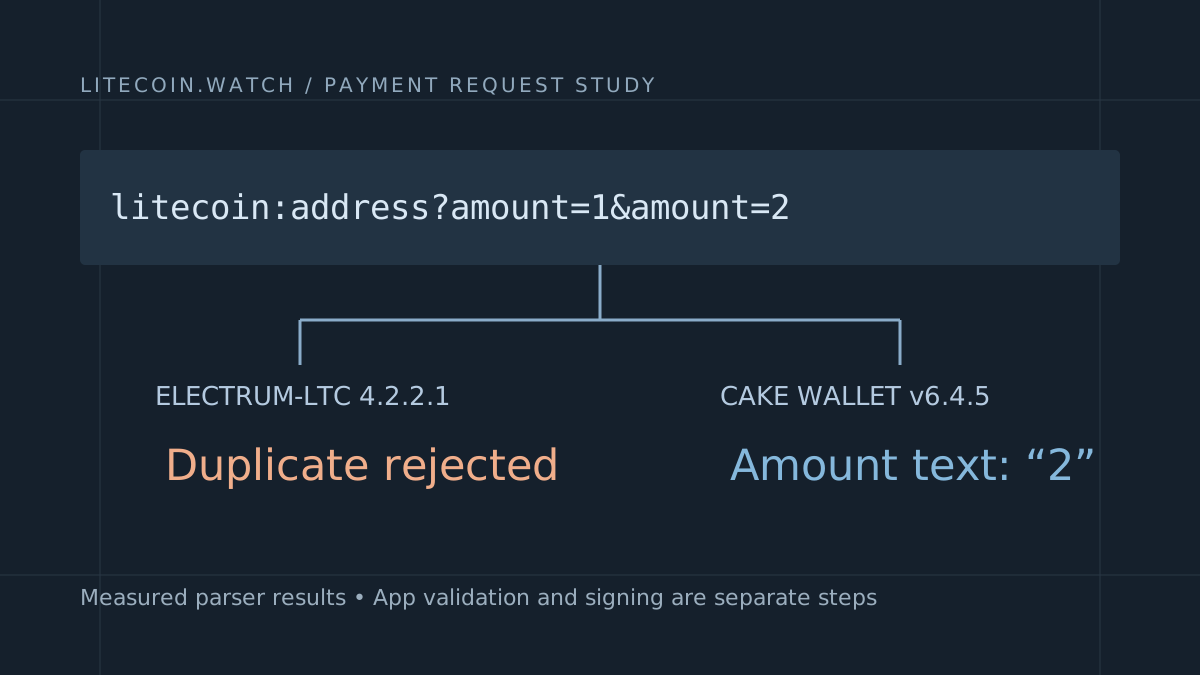
How two wallet parsers handle Litecoin payment requests
Twenty identical requests reveal differences in repeated amounts, decimal precision and metadata at the parsing boundary of Electrum-LTC and Cake Wallet. Exact versions, code and results are published.
Data / code included
Proof of reserves: how to read a crypto exchange report
Check asset scope and liabilities, review dated Kraken and OKX disclosures, and reproduce a Merkle example showing the limits of inclusion proofs.
Data / code included
Litecoin ahead of the September Fed decision: what to watch
A detailed preview of the September 15–16 FOMC meeting: verified policy and inflation data, LTC versus BTC charts, four conditional scenarios and downloadable market data.
Data / code included
Litecoin security revenue after halvings: what the arithmetic can tell us
A transparent subsidy model for LTC and DOGE, with clear limits on interpreting revenue as network security.

Litecoin withdrawal charges: compare the service quote with the network fee
How to compare a quoted withdrawal charge with an actual Litecoin transaction fee without inventing exchange margins.

What a 51% Litecoin attack estimate must assume
Our 42 hardware scenarios expose the capacity denominator and omitted costs. Download the model; it does not claim rentable supply or attack feasibility.
Data / code included
Litecoin and the digital euro: status, privacy and payment limits
Corrects the digital euro timeline and cap claims, distinguishes pilot and potential issuance, and compares payment routes without universal CBDC assumptions.

Can an AI agent pay with Litecoin? The controls a real payment needs
A payment request is only the start. A practical Litecoin integration must link an approved purchase to settlement and delivery, protect signing authority and reconcile uncertain attempts before retrying.

Litecoin price history: every cycle from 2011 to 2026, explained
Four boom-bust cycles, two sold-the-news halvings, one founder who cashed out at the top. Every major Litecoin cycle from 2011 to 2026, with the causes behind the numbers.

What Litecoin’s first 1,001 block headers actually show
Our header reconstruction finds 47 minutes 26 seconds from heights 3 to 1,000, plus backward timestamps. Download the records and reproduce the analysis.
Data / code included
Where the whales actually trade: LTC liquidity, order-book depth, and slippage
Reported LTC volume is a vanity metric. We map where real Litecoin liquidity sits, what a $1M market order actually costs, and how whales move size without leaving a footprint.

Who controls Litecoin? What pools and nodes can tell us
A pool can coordinate miners without owning their hardware, and a node count cannot identify independent operators. Learn what the evidence can establish.
Data / code included