


Building an LTC position with recurring purchases: arithmetic and risks
Worked DCA examples show weighted acquisition cost, fees and path dependence. Regular purchases cannot guarantee profits or eliminate concentration risk.
Reviewed 18 September 2026. All prices and purchase amounts below are hypothetical educational examples, not historical returns or a recommended allocation.
Dollar-cost averaging means investing a planned cash amount at repeated intervals. It can make a purchase process more consistent, but it cannot guarantee a profit or make an unsuitable exposure suitable. A recurring order still buys a volatile asset.
The previous article included unsupported trading-loss statistics and an unverified historical performance table. Those claims have been removed. A useful plan begins with arithmetic that can be reproduced.
How the average cost actually works
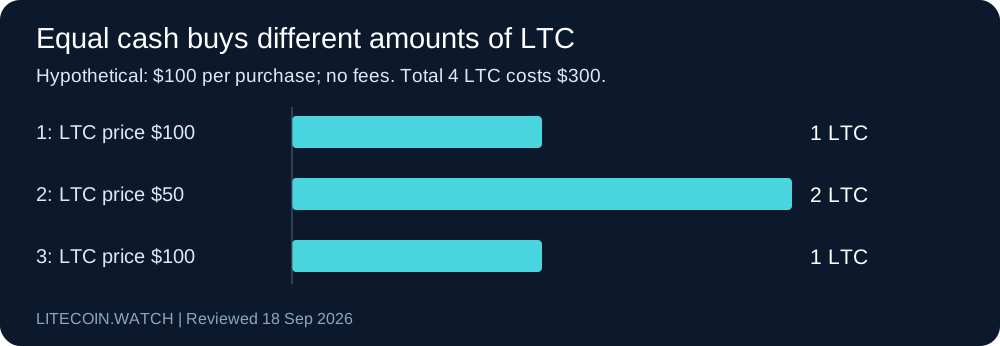
For each purchase, divide the cash used to buy LTC by its execution price. Add the acquired LTC, then divide total acquisition cost by total units. With equal cash contributions and no fees, this is a harmonic mean of the purchase prices, not their ordinary arithmetic average.
| Purchase | Cash invested | Price per LTC | LTC acquired |
|---|---|---|---|
| First | $100 | $100 | 1 |
| Second | $100 | $50 | 2 |
| Third | $100 | $100 | 1 |
| Total | $300 | — | 4 |
Average acquisition price is $300 / 4 = $75 per LTC. The simple average of the three quoted prices is approximately $83.33 and is not the position's cost per coin. If LTC subsequently trades at $60, the four coins are worth $240: a 20% loss before disposal costs.
Use the average-cost calculator to check multiple fills. Include fees according to how the platform charges them. A fee deducted from LTC reduces units received; a fee paid in cash increases the all-in acquisition cost. Keep both the exchange's gross trade and the net wallet receipt so they can be reconciled.
The price path changes the result
Regular purchases buy more units when prices are lower and fewer when they are higher. This property is arithmetic, not a prediction about which path will occur.
| Three successive prices | Three $100 purchases: total LTC | Value at the final price |
|---|---|---|
| $50, $100, $150 | 3.666667 | $550.00 |
| $100, $50, $25 | 7 | $175.00 |
Both examples invest $300. The falling path still loses approximately 41.67%. Acquiring more coins does not establish a successful financial outcome.
A comparison with investing $300 at the beginning is only fair if that money was actually available then. In the rising example, the initial lump sum buys six LTC and ends at $900. In the falling example, it buys three LTC and ends at $75. Neither example supplies a historical win rate or determines the better future strategy.
Write a plan that can be reviewed
Record the contribution schedule, maximum cash commitment, trading venue and custody arrangement. Decide what circumstances would trigger a review: changed household cash needs, unacceptable concentration, loss of access to a service or a material change in the investment thesis.
Separate contributions funded by new income from a deliberate delay in investing existing capital. The second decision leaves cash uninvested and introduces another opportunity cost. Borrowing to maintain a schedule changes the risk substantially and should not be hidden inside a supposedly simple accumulation plan.
The investment calculator can compare inputs, while portfolio tracking can record holdings. A projection is an output of the assumptions supplied to it; it is not a forecast or a tax return.
Costs and custody deserve their own checklist
Small frequent orders may incur disproportionately large fixed fees. Compare the all-in recurring-order price with the platform's ordinary order route, including spread and withdrawal charges. Moving every tiny purchase into self-custody may cost more than batching withdrawals, but leaving coins on a platform retains custody exposure.
Secure the account, check withdrawal addresses using a trusted channel and test recovery arrangements before they are needed. Review both the investment and the operational process at sensible intervals. A plan should be understandable enough that a missed payment or changed circumstance does not force an impulsive decision.
The Investor.gov explanation of dollar-cost averaging defines the general technique. Our calculations above are explicit illustrations and do not claim that the source endorses Litecoin.
The downloadable calculation sheet records the inputs and results of the illustrative DCA and related examples. It contains no historical market series.
Frequently asked questions
Does averaging guarantee a lower purchase price?
No. It produces a weighted acquisition cost across your actual fills. That cost can be higher than an earlier available price and higher than the eventual sale price.
Should the average include fees?
For an all-in performance calculation, include acquisition costs and the actual units received. Tax accounting can impose additional jurisdiction-specific rules.
Is a higher LTC balance the same as a gain?
No. Compare the position's realizable value with all money contributed and applicable costs. More units can coexist with a substantial loss.



Track Litecoin in real time
Rates for 30+ currencies. Check each tool for its latest source timestamp.
Open dashboard