


Litecoin DeFi: bridges, wrapped LTC, yield opportunities, and the risks
LitVM is on testnet. Wrapped LTC exists on Ethereum and BSC. CeFi lending platforms collapsed in 2022. Here is the honest state of Litecoin DeFi — what works, what does not, and what could kill your funds.
On this page
DeFi on Litecoin: the state of play in 2026
For most of its 15-year history, Litecoin had zero DeFi. No lending protocols, no automated market makers, no yield farms. The UTXO-based architecture that makes Litecoin excellent for payments makes it fundamentally incompatible with the smart contract logic that DeFi requires. You cannot build Uniswap on a chain that does not support smart contracts.
That is changing — slowly, tentatively, and with significant caveats. LitVM brings EVM compatibility to Litecoin via a ZK-rollup Layer-2. Wrapped LTC exists on Ethereum, BSC, and other chains. Cross-chain bridges connect Litecoin to the broader DeFi ecosystem. But "exists" and "thrives" are very different words, and anyone entering Litecoin DeFi in 2026 needs to understand exactly what they are walking into.
The three paths to Litecoin DeFi
Path 1: LitVM (native L2 — not yet live)
LitVM is Litecoin's own smart contract layer. It uses ZK-rollups to process transactions off-chain and post proofs to Litecoin's base layer. EVM compatible, so Solidity contracts deploy without modification. Gas fees paid in LTC.
As checked on 15 September 2026, the LitVM project site advertises the LiteForge testnet. This is not evidence that production deployment or a particular mainnet date is confirmed. Earlier 2026 roadmap dates and anticipated Summit announcements should be read as historical expectations.
Path 2: Wrapped LTC on other chains (live, limited)
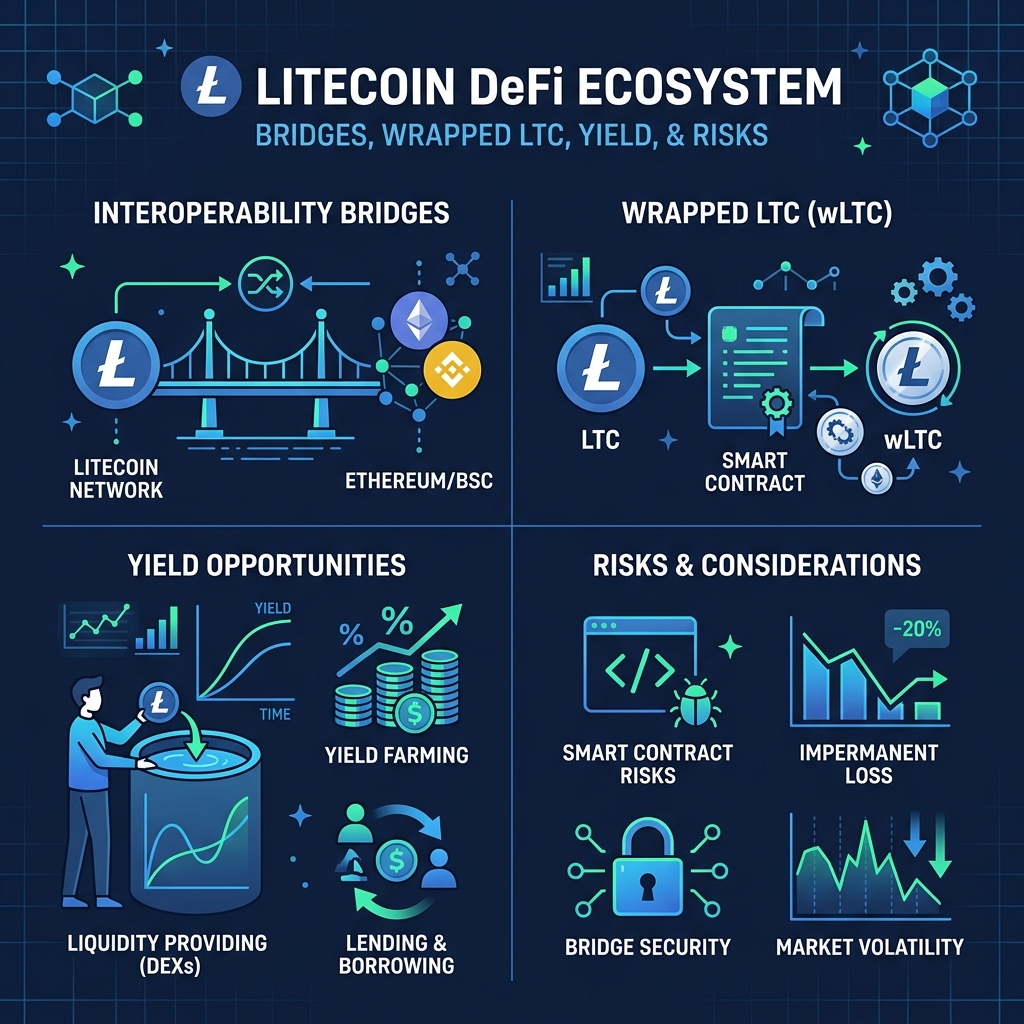
Wrapped Litecoin (wLTC) exists as ERC-20 tokens on Ethereum, BEP-20 on BSC, and similar wrapped versions on other chains. You deposit real LTC into a custodian or bridge, and receive a 1:1 token on the destination chain. That token can interact with any DeFi protocol on that chain.
| Wrapped LTC variant | Chain | Custodian/Bridge | Approximate TVL |
|---|---|---|---|
| wLTC (Ethereum) | Ethereum | Various bridges | Small (<$5M) |
| LTC BEP-20 | BSC | Binance bridge | Moderate |
| renLTC | Multi-chain | Ren Protocol (deprecated) | ~$0 (Ren shut down) |
The problem: wrapped LTC TVL is tiny. Liquidity pools for wLTC on Uniswap or PancakeSwap are shallow. Slippage on large swaps is high. And you are adding counterparty risk (the bridge/custodian) on top of the DeFi protocol risk. For a community that values self-custody and decentralization, wrapping LTC through a centralized bridge contradicts the ethos.
Path 3: Cross-chain swaps (atomic, trustless)
Atomic swaps allow direct LTC-to-BTC or LTC-to-other-crypto exchanges without an intermediary. The trade either completes fully or not at all — no counterparty risk, no bridge, no custody. Litecoin was one of the first chains to demonstrate atomic swaps (Charlie Lee executed an LTC/BTC atomic swap in 2017).
Atomic swaps are trustless but impractical for most users: they require both parties to be online, the UX is poor, liquidity is fragmented, and there are no automated market makers to provide instant quotes. They remain a niche tool for technical users, not a mainstream DeFi on-ramp.
Yield opportunities: what actually exists
Be extremely skeptical of any "Litecoin yield" offering. Here is what is real and what is marketing:
| Method | Typical yield | Risk level | How it works |
|---|---|---|---|
| CeFi lending (Nexo, etc.) | 2-5% APY | High (counterparty) | You lend LTC to a centralized platform; they lend it to borrowers |
| DEX liquidity provision (wLTC) | Variable (0.5-15%) | High (IL + bridge + smart contract) | Provide wLTC to AMM pools; earn trading fees |
| LitVM DeFi (future) | Unknown | Unknown (unproven L2) | Lending/LP on native LitVM protocols — does not exist yet |
| Simply holding LTC | 0% | Market risk only | No yield, no counterparty risk, no smart contract risk |
Bridge risk: the DeFi elephant in the room
Every path to Litecoin DeFi (except atomic swaps) requires a bridge. Bridges are the single largest source of funds lost in DeFi history:
- Ronin Bridge (March 2022): $625 million stolen via compromised validator keys
- Wormhole (February 2022): $320 million stolen via a smart contract vulnerability
- Nomad (August 2022): $190 million drained in a chaotic free-for-all exploit
- Harmony Horizon (June 2022): $100 million stolen via compromised keys
These are not obscure protocols — they were among the largest bridges in DeFi. If you bridge LTC to another chain for yield farming, you are trusting the bridge contract with your funds. If the bridge is exploited, your LTC is gone. There is no insurance, no FDIC, no recourse.
LitVM's approach (ZK-rollup with proofs posted to Litecoin L1) is architecturally different from these bridged systems — the trust assumption is Litecoin's own consensus, not a separate validator set. But the bridge between L1 and L2 is still a smart contract that can have bugs. The technology is newer and less battle-tested than the bridges that have already been exploited.
The honest assessment: should you pursue Litecoin DeFi?
- If you are a DeFi power user: wrapped LTC on Ethereum gives you access to the deepest liquidity pools, but the TVL is thin and bridge risk is real. Only use amounts you can afford to lose entirely
- If you are waiting for LitVM: patience. The testnet works but mainnet has no confirmed date. Do not bridge LTC in anticipation of LitVM DeFi that may be months away
- If you just want to hold LTC: holding in self-custody with zero counterparty risk is a perfectly valid strategy. You earn 0% yield but take 0% smart contract/bridge/counterparty risk. After the CeFi collapses of 2022, many experienced holders concluded that the safest yield on crypto is no yield at all
Store your LTC safely using our recommended wallets in the wallet guide. Monitor LTC value on our calculator.
Frequently asked questions
Can I use Litecoin in DeFi?
As checked on 15 September 2026, the LitVM project site advertises the LiteForge testnet. This is not evidence that production deployment or a particular mainnet date is confirmed. Earlier 2026 roadmap dates and anticipated Summit announcements should be read as historical expectations.
What is wrapped LTC?
A token on another blockchain (e.g., Ethereum) that represents 1:1 real LTC held in custody by a bridge or custodian. Wrapped LTC can interact with DeFi protocols on the destination chain, but introduces counterparty risk from the bridge.
Is it safe to lend my LTC for yield?
No crypto lending is risk-free. CeFi platforms (Celsius, Voyager, BlockFi) collectively lost over $10 billion in 2022. DeFi lending carries smart contract risk. Evaluate whether the yield (typically 2-5% APY) justifies the risk of losing 100% of your principal.
Sources
- LitVM — testnet documentation and architecture (litvm.com)
- DeFi Llama — TVL data for wrapped LTC across chains
- Rekt.news — bridge exploit database and post-mortem analyses
- CoinGecko — wrapped LTC token listings and liquidity data



Track Litecoin in real time
Rates for 30+ currencies. Check each tool for its latest source timestamp.
Open dashboard