Analysis

Litecoin halving 2027: history, mining impact, and how to trade it

The next halving: July 2027, block 3,360,000

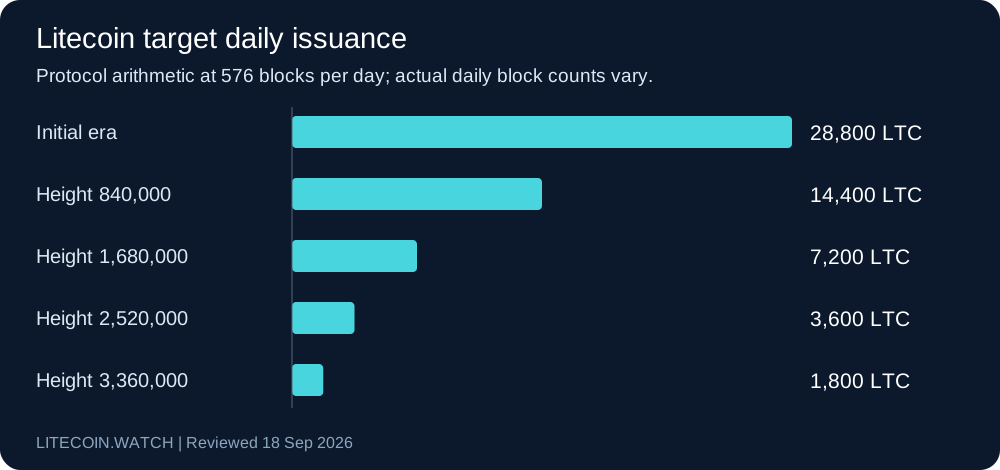
Litecoin's fourth halving will occur at block height 3,360,000, estimated around late July 2027. The block reward drops from 6.25 LTC to 3.125 LTC per block. Daily new supply falls from ~3,600 LTC to ~1,800 LTC. Annual inflation rate drops from approximately 1.7% to 0.85%. Track the exact block countdown on our halving countdown page.

That is the mechanical fact. What the halving means for price, miners, and the market is where the real analysis begins — and where most crypto content devolves into hopium. This article does not.

Complete halving history: the data, not the narrative

HalvingDateBlockReward changePrice at halvingPrice 6 months afterPrice 12 months after
1stAug 25, 2015840,00050 → 25 LTC$2.97$3.70 (+25%)$3.82 (+29%)
2ndAug 5, 20191,680,00025 → 12.5 LTC$99.60$44.50 (-55%)$43.00 (-57%)
3rdAug 2, 20232,520,00012.5 → 6.25 LTC$89.90$68.00 (-24%)$64.00 (-29%)
4th~Jul 20273,360,0006.25 → 3.125 LTC???

Look at that table carefully. The narrative that "halvings always pump the price" is not supported by Litecoin's actual history:

  • 2015 halving: modest gains in the following year. But LTC was a $35 million market cap asset — the data is barely relevant to today's market structure
  • 2019 halving: LTC pumped 300%+ in the months before the halving (from $30 in January to $146 in June), then collapsed 55% in the six months after. The halving was a classic "buy the rumor, sell the event." Traders who bought at the halving lost more than half their money within six months
  • 2023 halving: similar pattern. LTC ran up from $60 to $115 in the months before, then bled out -29% over the following year. Again: buying at the halving was a losing trade
War story — the 2019 halving trade that destroyed longs: In the summer of 2019, "halving pump" was the dominant narrative. LTC ran from $30 to $146 between January and June — a 5x move. Retail traders piled in with leverage, convinced the halving on August 5 would send it higher. Instead, LTC peaked two months before the halving and dumped relentlessly. By December, it was under $40. Leveraged longs who bought the actual halving day at $99 were liquidated as the price halved in four months. The 2023 cycle repeated this pattern almost identically. The lesson is simple but painful: Litecoin halvings are sell-the-news events, not buy-the-news events. The money is made in the months before, not after.

Why halvings matter (in theory)

The economic logic of halvings is straightforward supply-side analysis:

  • Supply reduction: miners receive 50% fewer LTC per block. If demand stays constant, reduced new supply should create upward price pressure over time
  • Miner sell pressure drops: miners are the largest natural sellers — they must sell LTC to cover electricity, hardware, and operational costs. Halving the reward halves the maximum amount they can sell. Post-halving, daily miner sell pressure drops from ~3,600 LTC ($194K at current prices) to ~1,800 LTC ($97K)
  • Stock-to-flow tightening: Litecoin's stock-to-flow ratio increases at each halving. After the 2027 halving, LTC's stock-to-flow will be approximately 98 — comparable to gold (approximately 62) and higher than silver (approximately 22). Whether stock-to-flow is a valid price model is debated, but the ratio itself is a mathematical fact
  • Narrative catalyst: regardless of the actual supply mechanics, the halving generates media coverage, social media discussion, and trader attention. This attention itself can become self-fulfilling — at least temporarily

Why halvings disappoint (in practice)

The theory sounds clean. The reality is messier:

  • Already priced in: the halving date is known years in advance. Every trader, every algorithm, every fund manager knows exactly when supply will drop. Markets are reasonably efficient at pricing known future events. By the time the halving actually occurs, the supply reduction has been anticipated and priced into the market for months
  • Pre-halving pump absorbs the move: as the data shows, LTC tends to rally 3-6 months before the halving as traders front-run the narrative. This pre-halving rally IS the halving trade. The actual event is the exit point for those traders, not the entry
  • Bitcoin dominates the cycle: Litecoin's price is heavily correlated with Bitcoin. The 2019 and 2023 halvings both occurred during periods when BTC was consolidating or declining. A Litecoin halving during a Bitcoin bear market is a halving that does not pump. Period
  • Miner capitulation risk: when rewards halve, miners with high operating costs become unprofitable. They either shut down (reducing hashrate and security) or dump inventory to cover costs (creating selling pressure). The first weeks after a halving can see accelerated miner selling, not reduced selling

The 2027 halving: what is different this time

Every halving cycle brings the "this time is different" argument. Here is an honest assessment of what actually is different in 2027:

Structural changes (genuinely new)

  • LTCC spot ETF exists: for the first time, a Litecoin halving occurs with a regulated spot ETF on Nasdaq. If institutional interest grows pre-halving, ETF inflows add a demand source that did not exist in 2019 or 2023
  • SEC commodity classification: the March 2026 ruling removed regulatory ambiguity. Institutional capital that was sidelined by classification uncertainty can now enter
  • LitVM smart contracts: if LitVM's mainnet is live and generating real TVL by mid-2027, LTC has a demand source from gas consumption that did not exist in previous cycles
  • MWEB adoption: 350,000+ LTC locked in MWEB confidential transactions, effectively reducing circulating supply. This was not a factor in any previous halving
  • Lite Strategy corporate treasury: a public company holding 929,548 LTC as a reserve asset creates a structural holder that did not exist before
  • 91% already mined: at the time of the 2027 halving, approximately 93% of all LTC will have been mined. The remaining 7% will be released over the next ~116 years. The supply is already nearly fully distributed

What is NOT different

  • BTC correlation remains dominant: LTC will still move primarily with Bitcoin. If BTC is in a bear market in July 2027, the LTC halving will not save it. No halving has ever overcome a bear market cycle
  • The pre-halving pattern will likely repeat: expect LTC to rally in Q1-Q2 2027 as the narrative builds, and expect the actual halving to be a sell event. The pattern has held for 3/3 Litecoin halvings and 3/4 Bitcoin halvings
  • Leverage will amplify the damage: traders will load up on long positions heading into the halving. Some will be right (if they exit before the event). Many will be liquidated on the post-halving dump. Funding rates on LTC perpetuals will be your signal — extremely positive funding rates = overleveraged longs = incoming liquidation cascade

Mining economics post-halving

The halving directly impacts miners, who are the infrastructure providers that secure the Litecoin network:

MetricPre-halving (current)Post-halving (2027)
Block reward6.25 LTC3.125 LTC
Daily new supply~3,600 LTC~1,800 LTC
Annual new supply~1.31 million LTC~657,000 LTC
Inflation rate~1.7%~0.85%
Revenue per block (at $54)$337.50$168.75
Break-even requirementLTC must exceed mining costLTC must be 2x current mining cost, or costs must halve

For the network to maintain its current hashrate (3.34 PH/s, an all-time high), one of three things must happen: LTC price must roughly double, electricity costs must drop significantly, or mining hardware must become more efficient. If none of these occur, some miners will shut down, hashrate drops, difficulty adjusts downward, and the remaining miners become profitable again. This self-correcting mechanism has worked through every previous halving, but the transition period can be turbulent.

Luxxfolio Holdings, the first publicly traded LTC miner, will face this economics challenge directly. Their profitability report after the halving will be a real-world test of whether institutional mining can survive a 50% revenue cut. Track current mining data on our mining dashboard.

How to trade the halving: the pattern and the pitfalls

Based on three previous Litecoin halvings and four Bitcoin halvings, here is the playbook that has historically worked — with heavy caveats:

  1. Accumulate 6-12 months before (Q3 2026 - Q1 2027): the pre-halving narrative builds slowly, then accelerates. Early positioning captures the bulk of the move. This is not timing advice — it is pattern recognition from seven previous halving cycles across BTC and LTC
  2. Watch for the blow-off top 1-3 months before: LTC has historically peaked 2-3 months pre-halving, not at the halving itself. When social media goes euphoric, when "LTC to $500" predictions flood Twitter, when funding rates on perpetuals go extremely positive — that is the signal to reduce exposure, not increase it
  3. Do not buy the halving day: 3/3 Litecoin halvings have been followed by price declines within 6 months. Buying the actual halving is statistically the worst entry point in the cycle
  4. Monitor BTC for the macro signal: if Bitcoin is in a bull market during the LTC halving, the damage from sell-the-news may be contained. If Bitcoin is in a bear market, no halving narrative will save LTC. Check the LTC/BTC ratio for relative positioning
The leverage warning: Funding rates on LTC perpetual swaps are the clearest indicator of overleveraged positioning. When perpetual funding rates are extremely positive (>0.05% per 8 hours), it means longs are paying shorts to maintain their positions — a sign the market is crowded on one side. Historically, extremely positive funding rates before a halving have preceded violent liquidation cascades within weeks. If you use leverage around the halving, you are almost certainly the exit liquidity for someone else's trade.

Supply math: the full picture

  • Total supply cap: 84,000,000 LTC
  • Mined by halving date (~July 2027): approximately 78,000,000 LTC (93%)
  • Remaining to be mined: approximately 6,000,000 LTC over the next ~116 years
  • Lost/inaccessible coins: estimated 5-15% of mined supply is permanently lost (lost keys, dead wallets, sent to burn addresses). This further reduces effective circulating supply
  • MWEB locked: 350,000+ LTC in confidential transactions (not lost, but removed from transparent circulation)
  • LTCC ETF: holds LTC in cold storage custody, removing it from exchange order books
  • Lite Strategy: 929,548 LTC in corporate treasury

When you add up ETF holdings, MWEB locks, corporate treasury, and estimated lost coins, a significant portion of LTC's supply is structurally illiquid. The halving reduces new supply into a market that already has less available inventory than raw numbers suggest. Monitor supply metrics on our on-chain dashboard.

Frequently asked questions

When exactly is the next Litecoin halving?

The halving occurs at block 3,360,000, estimated around late July 2027. The exact date depends on block production speed (target: 2.5 minutes per block). Track the real-time countdown on our halving page.

Does the halving guarantee a price increase?

No. Historical data shows Litecoin has declined in the 6-12 months following each of its three previous halvings. The halving reduces new supply, but price depends on overall market conditions, Bitcoin's trajectory, and demand dynamics. The strongest moves have occurred before the halving, not after.

What happens to miners after the halving?

Miners receive 50% less LTC per block. Those with high operating costs may become unprofitable and shut down. Hashrate may temporarily decline before difficulty adjusts. The network self-corrects, but the transition period can last weeks to months.

Should I sell before or after the halving?

This is not financial advice. Historical patterns suggest the pre-halving rally (3-6 months before) captures most of the upside, and the halving itself has been a sell event in 3/3 previous LTC cycles. Your strategy should depend on your cost basis, tax situation, and market conditions. Always consider the broader Bitcoin cycle.

Sources

  • Litecoin blockchain data — block heights, reward schedules, halving dates
  • CoinGecko / CoinMarketCap — historical LTC prices at halving dates
  • Litecoin Block Half — halving countdown and block production data
  • Glassnode — on-chain metrics, miner revenue, and supply analysis
  • Coinglass — funding rates, open interest, and liquidation data for LTC perpetuals
Jarosław Wasiński
Jarosław Wasiński
Editor-in-chief · Crypto, forex & macro market analyst

Independent analyst and practitioner with over 20 years of experience in the financial sector. Actively involved in forex and cryptocurrency markets since 2007, with a focus on fundamental analysis, OTC market structure, and disciplined capital risk management. Creator of MyBank.pl (est. 2004) and Litecoin.watch — platforms delivering reliable, data-driven financial content. Author of hundreds of in-depth market commentaries, structural analyses, and educational materials for crypto and forex traders.

20+ years in financial marketsActive forex & crypto trader since 2007Founder of MyBank.pl (2004) & Litecoin.watch (2014)Specialist in fundamental analysis & risk management

Track Litecoin in real time

Live rates for 30+ currencies, updated every second

Open dashboard