


Using a Litecoin whale tracker: transfers, labels and signal limits
Use large-transfer alerts as research leads. Check timestamps, outputs and address labels before drawing conclusions about ownership or price.
Reviewed 18 September 2026. Large transfers are observations to investigate, not automatic buy or sell signals.
A Litecoin whale tracker can help identify unusually large on-chain movements. It cannot directly read the owner's intentions, determine whether a trade occurred, or turn an address into a verified person. The useful question is what the available record supports.
The earlier article assigned precise balances to exchanges, institutions and supposedly lost coins without a reconciled dataset. Those ownership estimates and the unverified March transfer anecdote have been removed.
Define what the alert measures
A threshold can refer to LTC units, an estimated fiat value, an input total or selected outputs. These are different filters. For fiat thresholds, retain the price source and timestamp used for conversion.
“Recent” also needs a precise definition. A historical transaction is not fresh merely because a tracker fetched or rediscovered it today. Record both the block timestamp and the observation time, especially when an upstream service returns old data.
| Field to retain | Purpose |
|---|---|
| Full transaction ID and network | Allows reproduction |
| Confirmation state and block height | Distinguishes pending and confirmed observations |
| Block time and observation time in UTC | Prevents old events being described as new |
| Amount definition | Separates input totals, outputs and inferred payments |
| Address-label source | Exposes attribution assumptions |
| Price source and timestamp | Makes fiat estimates reproducible |
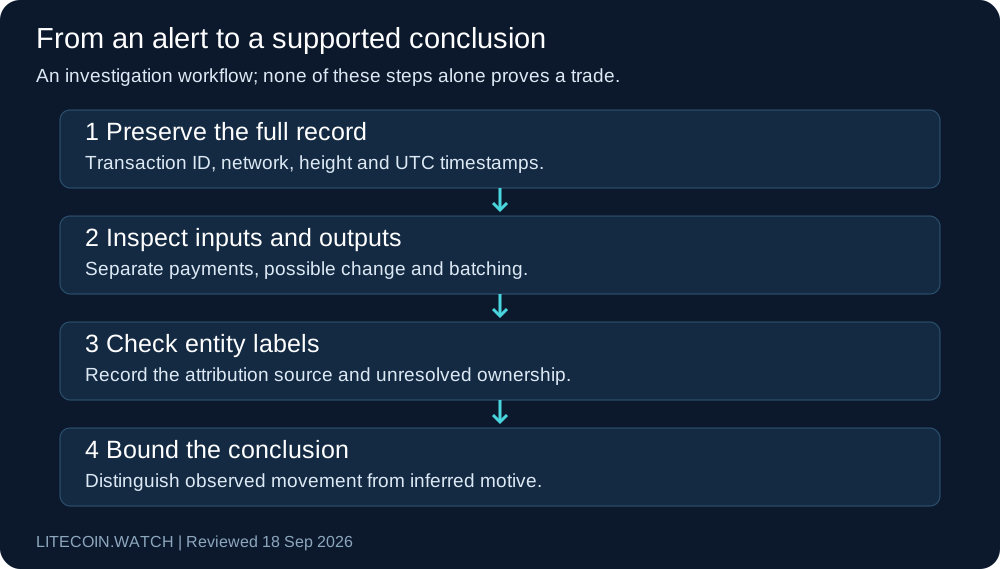
Use the Whale Tracker as a starting point, then inspect the full transaction. A screenshot of a large number is not a complete evidence record.
Follow the outputs before interpreting the motive
In Litecoin's UTXO model, a transaction spends existing outputs and creates new ones. It may include recipient payments, change, multiple customers' withdrawals or an internal consolidation. The Core transaction structure is the underlying record; ownership classifications sit above it.
A hypothetical transaction consuming 500 LTC and returning 449.999 LTC as change while paying 50 LTC and a 0.001 LTC fee is not a 500 LTC purchase. Identifying which output is change can itself be uncertain. Do not silently treat a heuristic as verified attribution.
Interpret exchange labels carefully
A deposit to an exchange-controlled address can support the narrow statement that funds arrived at an address classified as belonging to that exchange. It does not prove an immediate sale. The transfer might be collateral, settlement, custody migration or an internal movement.
Likewise, a withdrawal can follow an earlier purchase or move funds between two wallets controlled by one organization. “Unknown” means the label provider has not identified the destination. It does not mean a new long-term investor.
| Pattern | Plausible explanation | Missing evidence |
|---|---|---|
| Large exchange inflow | Deposit, internal sweep or collateral | Whether an asset was sold |
| Large exchange outflow | Customer withdrawal or wallet reorganization | Whether ownership changed |
| Many inputs consolidated | Wallet maintenance | Number of independent owners |
| Many outputs created | Batched payments or withdrawals | Economic purpose of each output |
Address concentration is not owner concentration
One custodial address can represent many customers. One person can control many addresses. Transparent address lists also do not provide a complete public balance sheet of confidential MWEB activity.
Adding fund holdings to custodian address balances can count the same coins twice. Similarly, subtracting a speculative “lost coin” estimate from supply does not create a verified tradable-float figure. An ownership study needs explicit definitions, compatible dates and a method for avoiding duplicates.
Evaluate an alert's predictive value
Choose a rule before testing it: amount threshold, label coverage, time window and the outcome to measure. Include every qualifying observation, including those followed by no price move or the opposite move. Compare results with an appropriate market benchmark and account for trading costs.
An isolated successful anecdote does not establish predictive power. If an alert became public after the price moved, it cannot be credited with providing advance information to readers.
For a concrete example of editorial uncertainty, see our review of the reported 1.25 million LTC withdrawal. The distinction between a circulated report and independently verified transaction evidence is central to responsible whale coverage.
Frequently asked questions
Does a whale transfer mean a trade happened?
No. Blockchain movement and exchange execution are different events.
Can a tracker identify a wallet owner with certainty?
Only where reliable attribution supports it. Address labels should include their source and uncertainty, and they generally do not identify every beneficial owner.
Why are old transactions still useful?
They can illustrate mechanics or support historical analysis. They should be dated clearly and excluded from claims about fresh activity.



Track Litecoin in real time
Rates for 30+ currencies. Check each tool for its latest source timestamp.
Open dashboard