


ChangeNOW's two-confirmation LTC policy: what the speed claim means
The provider announced five confirmations reduced to two. Worked timing examples distinguish expected block waits from complete swap performance.
Reviewed 18 September 2026. The March announcement below is a provider claim, not a new independent speed test.
On 17 March 2026, ChangeNOW announced that its Litecoin deposit threshold had fallen from five confirmations to two. The statement appeared in a provider press release distributed through Chainwire and published by Decrypt. Decrypt identifies the item as sponsored press-release content.
That supports a report about the announced threshold. It does not establish that every swap now finishes in five minutes, that this remains the rule for every transaction, or that ChangeNOW is the fastest service in a comprehensively tested market.
What “2.5 times faster” actually describes
The ratio of five confirmations to two is 2.5. Reducing a threshold from five to two removes 60% of the required confirmations. If all other assumptions remain unchanged, the expected block-wait component falls by the same proportion.
Litecoin's target block interval is 150 seconds, or 2.5 minutes, under its mainnet parameters. This gives the following idealized expectations for a transaction eligible for inclusion in the next block:
| Threshold | Expected wait from broadcast under the model | Remaining expected wait after its first confirmation |
|---|---|---|
| Five confirmations | 12.5 minutes | 10 minutes |
| Two confirmations | 5 minutes | 2.5 minutes |
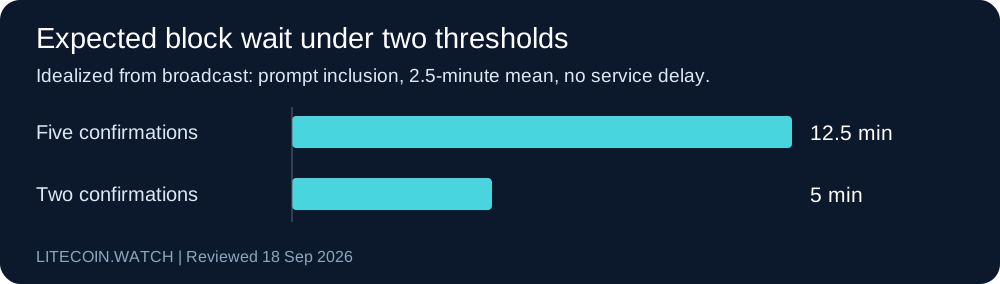
These calculations assume a stable average block interval, prompt inclusion and no additional service delays. They are not measured ChangeNOW completion times. Blocks do not arrive on a fixed timetable, and a transaction may wait for inclusion. The distinction between “from broadcast” and “after first confirmation” matters when comparing two dashboards.
Deposit acceptance is only one stage
A complete swap can include several steps: the user's wallet broadcasts, the deposit reaches the required chain state, the provider checks and processes it, the output transaction is sent, and the receiving service credits it.
Shortening the deposit threshold changes one stage. Quote conditions, liquidity, security checks, operational incidents and the destination network can still affect the end-to-end result. A receiving exchange may require further confirmations even after the swap provider has sent the output.
The announcement describes a dynamic processing system. Readers should check the live order's terms and status instead of assuming a historical press release guarantees the current handling of a particular transfer.
Fewer confirmations are a service risk decision
A confirmation is inclusion in a block, with additional confirmations reflecting subsequent blocks on the accepted chain. More confirmations generally increase the amount of work that would have to be displaced in a reorganization; they do not eliminate every operational or software risk.
There is no universal rule that two confirmations are sufficient for every value, merchant or risk model. The provider can select a threshold appropriate to its exposure, but its selection is not a network-wide consensus change.
This distinction also prevents a common misunderstanding: ChangeNOW has not made Litecoin's protocol produce blocks 2.5 times faster. It announced a change in when its own service is prepared to process a deposit.
How to compare services fairly
| Record | Why it matters |
|---|---|
| Network, asset and transaction amount | Policies may differ across routes or exposure |
| Broadcast and first-confirmation timestamps | Separates wallet/network delay from later processing |
| Deposit accepted and output broadcast times | Measures the service's own stage |
| Recipient credited time | Captures the complete customer experience |
| Quote type, fees and final received amount | Speed alone does not measure value |
Use several documented observations before drawing a performance conclusion. Preserve failed or delayed attempts rather than selecting only the fastest. We did not execute such a benchmark for this article, and the previous comparative “fastest” language has been removed.
For amount conversions, the Litecoin calculator can provide a reference. A calculator quote is not an executable exchange offer and does not include every provider spread or fee.
Frequently asked questions
Does two confirmations mean an exact five-minute wait?
No. Five minutes is an idealized expectation using the target interval. Actual block timing, inclusion and service processing vary.
Did this change Litecoin consensus rules?
No. A deposit threshold is the service's acceptance policy. It does not change Litecoin's block interval or validation rules.
Was the announcement independently benchmarked here?
No. The reported change is attributed to the provider's dated announcement. This article supplies arithmetic and a method for testing the complete experience.



Track Litecoin in real time
Rates for 30+ currencies. Check each tool for its latest source timestamp.
Open dashboard