


Litecoin and Dogecoin: the merged mining alliance most people do not understand
Understand how Litecoin and Dogecoin reuse Scrypt work while retaining separate chains. Compare reward rules, pool payouts and shared-energy accounting.
On this page
Litecoin and Dogecoin can be mined using the same Scrypt hashing work through auxiliary proof of work, commonly called merged mining. They remain separate networks with separate blocks, balances and consensus rules.
The important economic question is how combined revenue supports miners. The important technical distinction is that sharing work does not combine the blockchains or make their security identical.
How one stream of work serves two chains
A participating pool prepares an auxiliary-chain block commitment and includes the appropriate commitment in the parent mining job. Miners perform Scrypt work. A result that meets the auxiliary chain's difficulty can be submitted with a proof connecting it to the parent work.
Whether a result also qualifies as a Litecoin block depends on Litecoin's own target. A Dogecoin block does not require a simultaneous accepted Litecoin block. The pool must implement the proof construction and submission correctly.
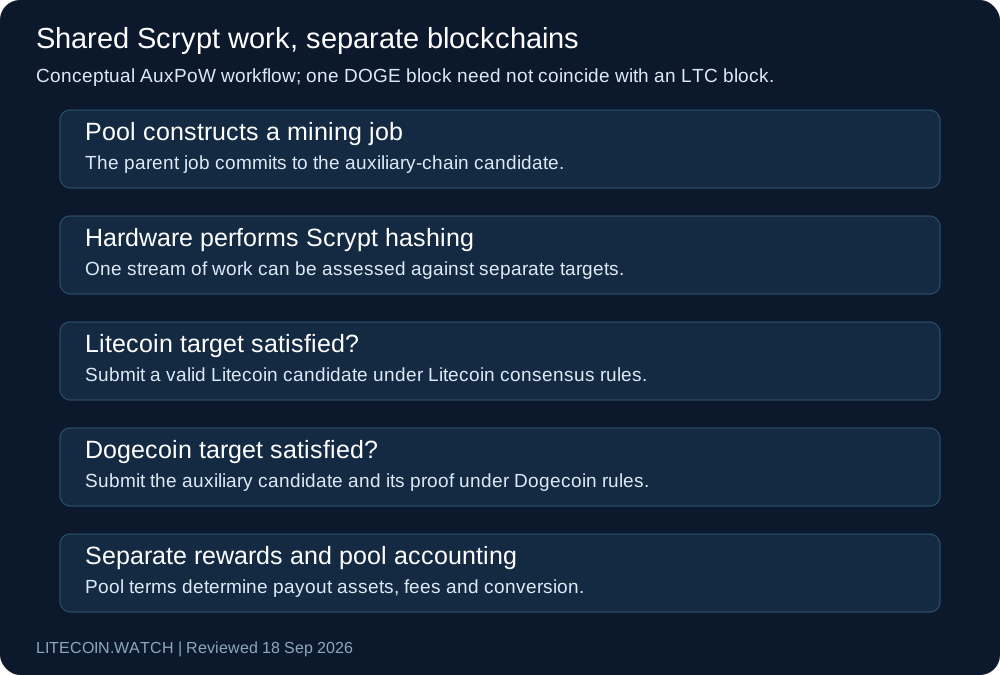
The detailed validation rules are in Dogecoin's AuxPoW implementation. This diagram is conceptual; it is not a complete wire-format specification.
When Dogecoin adopted AuxPoW
Dogecoin Core developers document activation at block 371,337 on 11 September 2014. The release of supporting software and the activation height are different events; treating an August software release as the activation date causes confusion.
The developers' later compatibility postmortem also shows why old client compatibility should not be assumed indefinitely. Follow supported software and current release notices, rather than using an old version because it once accepted merged-mined blocks.
Shared work, different rules
| Property | Litecoin | Dogecoin |
|---|---|---|
| Proof-of-work family | Scrypt | Scrypt with AuxPoW support |
| Target block interval | 150 seconds | 60 seconds |
| Subsidy model | Halving every 840,000 blocks | Ongoing 10,000 DOGE per block after the initial schedule |
| Ledger and balances | Litecoin chain | Dogecoin chain |
| Validation | Litecoin nodes enforce LTC rules | Dogecoin nodes enforce DOGE and AuxPoW rules |
| Wallet compatibility | Requires a Litecoin destination | Requires a Dogecoin destination |
The parameters are defined in Litecoin's chain settings, Dogecoin's chain settings and Dogecoin's subsidy code. The Litecoin reference is pinned to the reviewed release; Dogecoin's master links may change.
At target intervals, 10,000 DOGE per block corresponds to about 14.4 million DOGE per day, or 5.256 billion over a 365-day year. These are target-rate calculations, not exact observed daily issuance. At the 6.25 LTC subsidy, Litecoin's equivalent is about 3,600 LTC per day before its next halving.
Why it matters to mining economics
A pool's gross coin revenue can include LTC subsidy and fees, DOGE subsidy and fees, and potentially other supported auxiliary assets. Converting those rewards into a common currency helps compare revenue with electricity and operating costs.
Do not add the two networks' reported hashrates as though they necessarily represent two independent fleets. The same work may contribute to both. Similarly, assigning the full shared electricity consumption to each network and then summing them double counts energy.
The energy-estimation guide separates hardware efficiency, hash rate and facility overhead. The mining calculator can support scenarios, but its result depends on the coins and payout assumptions it actually includes.
A pool checklist before connecting hardware
| Check | Why it matters |
|---|---|
| Which auxiliary coins are credited? | Support for merged mining does not promise every reward is passed through |
| Are payouts separate or converted? | Conversion adds price, spread and accounting considerations |
| What are the fees and payout method? | PPS, PPLNS and other arrangements allocate variance differently |
| Are minimum withdrawals practical? | Small balances can remain below payout thresholds |
| How are stale shares handled? | Accepted work and paid work may differ |
| What records can be exported? | Coin quantities, timestamps and fees are needed for reconciliation |
Test the pool's reporting and payout process with a limited commitment. Avoid calculating a purchase decision from one unusually profitable day. Hardware availability, noise, cooling, tariffs, downtime and resale value can dominate a spreadsheet result.
What merged mining does not guarantee
It does not fix an exchange rate between LTC and DOGE. It does not guarantee that doubling the number of reward assets doubles profit. It does not create a minimum market price for either coin.
Shared miners also do not mean every attack scenario is identical. Difficulty targets, participating hash power, pool concentration, validation rules and software defects all matter. A protocol upgrade on one chain does not automatically upgrade the other.
Litecoin halvings reduce one component of combined revenue. The effect on the mining fleet depends on other revenues and costs at that time. See the reward schedule for the exact LTC subsidy boundaries.
Frequently asked questions
Can I send DOGE to a Litecoin address because the coins are merged mined?
No. Shared mining work does not make addresses, balances or transfers interchangeable. Use the exact coin and network supported by the recipient.
Does my miner automatically receive DOGE when it mines LTC?
Not necessarily. Pool support, reward allocation and payout settings determine what you receive.
Does merged mining use twice as much electricity?
It reuses hashing work rather than requiring two independent hashing runs. There is additional software and infrastructure work, but assigning all shared energy twice is not a sound estimate.



Track Litecoin in real time
Rates for 30+ currencies. Check each tool for its latest source timestamp.
Open dashboard