
Why a Litecoin limit order can fill instantly, partly or not at all
Twelve reproducible order scenarios separate price limits, maker/taker roles and unfilled quantities. Follow a worked cash balance, cancellation and a queue example without risking money.

Sources, review record & reproducibility
Downloadable data or code · Calculation model.
Content review recorded: 2026-10-03. The review record does not identify a separate independent reviewer. An edited date above records an edit, not a new fact-check.
Next scheduled review: 2027-01-01.
Sources saved with the review:
- raw.githubusercontent.com · /litecoin-project/litecoin/v0.21.5.8/src/chainparams.cpp
- raw.githubusercontent.com · /litecoin-project/litecoin/v0.21.5.8/src/key_io.cpp
- raw.githubusercontent.com · /bitcoin/bips/master/bip-0013.mediawiki
- docs.cdp.coinbase.com · /api-reference/exchange-api/rest-api/orders/create-new-order
- support.kraken.com · /articles/7987518770708-other-order-options
- litecoin.watch · /uploads/research/beginner-address-orders-20261003-v1/README.txt
See the article body for source links and any downloadable materials. Editorial method · Corrections · Report an issue
On this page
You place a Litecoin limit buy and expect the lower maker fee. It fills immediately and charges a taker fee. Another limit buy shows “open” after part of the amount was purchased. Neither result is necessarily a bug: a limit price, liquidity role and instruction for the unfilled remainder are different controls.
A buy limit sets a maximum execution price. It does not guarantee that the order waits, fills completely or earns a maker fee. A marketable limit can immediately consume sell orders. Post-only changes the liquidity condition; IOC and FOK change what happens when immediate liquidity is insufficient.
We built a small deterministic matching model with a declared three-level LTC/EUR book. Twelve scenarios hold the book and order intentions visible, so you can inspect each fill, remaining quantity and fee. This is original calculation work, not an exchange experiment. No account was opened and no order was sent.
Start with a book you can calculate by hand
Our synthetic book contains these sell offers. Its best bid is assumed to be €59.90. The prices are teaching inputs, not a historical snapshot or today's quotes.
| Ask price per LTC | LTC available at that price | Cumulative LTC |
|---|---|---|
| €60.00 | 0.50 | 0.50 |
| €60.10 | 1.00 | 1.50 |
| €60.40 | 1.50 | 3.00 |
A modeled market purchase of 2 LTC takes 0.5 at €60.00, 1 at €60.10 and 0.5 at €60.40. The notional is €120.30, giving an average fill price of €60.15. Looking only at the €60.00 best ask would understate the notional by €0.30.
0.5 × €60.00 = €30.00
1.0 × €60.10 = €60.10
0.5 × €60.40 = €30.20
Total: 2.0 LTC for €120.30 before fees
Our assumed taker fee is 0.20% of executed notional, paid in EUR. The modeled fee is €0.24060 and cash debit is €120.54060. The extra decimal places expose the calculation; actual venues can use different precision, currencies and per-fill rounding. The fee rates are invented inputs, not quoted Kraken or Coinbase tiers.
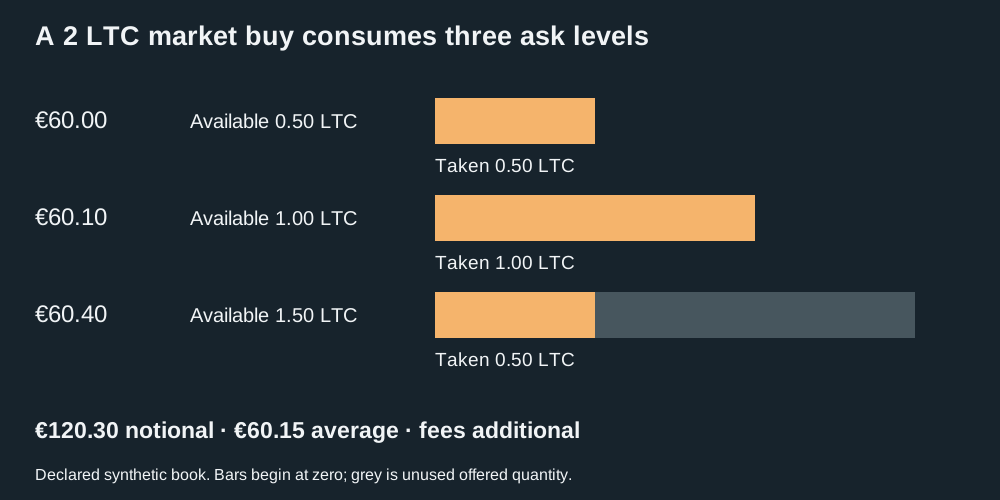
The same 2 LTC instruction has several possible outcomes
In the model, “market” walks available asks without a price cap. A buy limit walks only asks at or below the cap. A marketable post-only instruction is rejected rather than repriced. All immediate fills consume existing offers and are labeled taker.
| Instruction | Bought now | Still open | What happens to the rest |
|---|---|---|---|
| Market | 2 LTC | 0 | Fully filled across three prices |
| Limit €60.40, GTC | 2 LTC | 0 | Same immediate fills as market in this book |
| Limit €60.10, GTC | 1.5 LTC | 0.5 LTC | Remainder rests at the limit |
| Limit €60.10, IOC | 1.5 LTC | 0 | Unfilled 0.5 LTC is cancelled |
| Limit €60.10, FOK | 0 | 0 | All cancelled: only 1.5 LTC is immediately available within the cap |
| Limit €60.10, post-only | 0 | 0 | Rejected because it would take liquidity |
| Limit €59.90, post-only | 0 | 2 LTC | Posted; no seller currently meets the price |
| Limit €59.90, IOC | 0 | 0 | All cancelled; nothing can execute immediately within the cap |
GTC means good till cancelled. IOC means immediate or cancel: an immediately executable part can fill while the rest is cancelled. FOK means fill or kill: the immediate instruction requires the full quantity or no execution. Availability and exact implementations depend on the venue and product. Check the current spot-order documentation before choosing an option.
The Coinbase Exchange order reference describes order attributes and lifecycle. Kraken's spot order-options guide explains its post-limit control. These references establish documented concepts; our model does not reproduce either venue's complete engine or interface.
A limit of €60.40 does not force every unit to cost €60.40. The modeled buyer receives better existing asks first. It is a ceiling on fills, not the price that must appear on every trade.
Why “limit” does not mean “maker”
The €60.10 GTC limit immediately buys 1.5 LTC from existing asks. Those fills remove liquidity, so our model charges the assumed taker rate. The remaining 0.5 LTC becomes a resting buy order. If a later seller takes that resting order, the later fill can have a maker role.
We include that later fill as a separately declared event, not a prediction. The model assumes an incoming seller fills the whole remainder at €60.10 with no competing order ahead at that price. Under the assumed 0.10% maker and 0.20% taker rates, the fee calculation is:
Immediate taker fills: €90.10 × 0.20% = €0.18020
Assumed later maker fill: €30.05 × 0.10% = €0.03005
Total modeled fee:                         €0.21025
The completed order has €120.15 notional, €0.21025 fees and €120.36025 cash debit. Its maker and taker fills are parts of one order. Assigning the maker rate to the entire notional would understate the modeled fee by €0.09010.
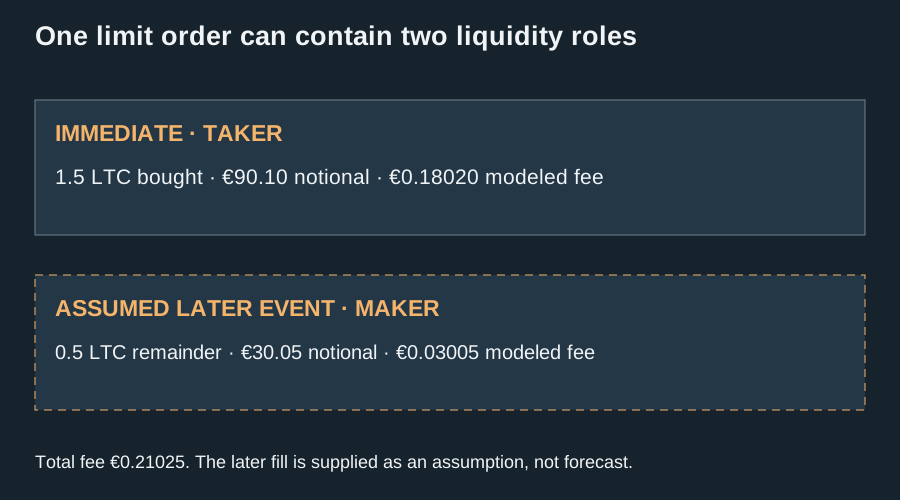
This later-event scenario cannot establish that waiting beats an immediate purchase. The future seller was supplied as an assumption. In a real market, the remainder can stay unfilled, the price can move away or the order can be cancelled. A lower fee on a fill that never occurs does not deliver the coins needed for a payment.
Partial execution changes what you own
An open 2 LTC order is not necessarily 2 LTC of holdings. After the €60.10 GTC case's initial execution, our account owns 1.5 LTC from that purchase. The remaining 0.5 LTC is an intention to buy, not a coin receipt.
To illustrate held funds, give the model account €150 and reserve the open remainder's maximum notional plus the assumed taker fee. This conservative reserve is an explicit teaching rule, not a measured exchange balance. Different products can reserve differently.
| Stage | LTC bought | EUR cash remaining | Reserved EUR | Free EUR |
|---|---|---|---|---|
| Before order | 0 | €150.00000 | €0 | €150.00000 |
| 2 LTC at €60.10 submitted, before matching | 0 | €150.00000 | €120.44040 | €29.55960 |
| 1.5 LTC immediately filled; 0.5 open | 1.5 | €59.71980 | €30.11010 | €29.60970 |
| Remaining 0.5 LTC cancelled | 1.5 | €59.71980 | €0 | €59.71980 |
Cancelling the remainder releases its modeled reserve. It does not reverse the 1.5 LTC already bought or refund its execution fee. A final “done” or cancelled order can therefore have nonzero executed quantity. Read filled quantity and fills, not just one status label.
Before withdrawing, check the acquired LTC that is actually available for withdrawal. Funding holds, account restrictions and withdrawal minimums are additional constraints. Our exchange-account guide separates those service states from public-chain transactions. The portfolio reconciliation exercise shows why importing requested order size as acquired LTC can create a false balance.
Seeing a price trade does not prove your order filled
A chart shows trades; it does not show your exact queue position. In our separate FIFO teaching example, another buyer already has 2 LTC ahead of us at €59.90. Our own 2 LTC buy is next. An incoming 1 LTC market seller trades at that price but fills only the earlier buyer. Our order gets zero.
A second incoming sale of 1.5 LTC consumes the earlier buyer's remaining 1 LTC and fills 0.5 LTC of ours. Our own 1.5 LTC remainder is still open. Both sell events occur at the same price, yet their effect on our order differs.
This example assumes simple price-time priority, one earlier order and no hidden or changing liquidity. It is not a reconstruction of any real exchange queue. Aggregate public book levels do not normally reveal the complete priority, cancellations and processing conditions needed to promise your fill. Check the account's execution report.
A price touching a line drawn on a chart, a visible buy wall or an order appearing in the book is therefore weaker evidence than an actual fill. Avoid repeatedly submitting replacement orders merely because a chart touched your limit; you can end up with more open quantity than intended.
Market orders also have boundaries
A market instruction favors immediate execution rather than a user-specified limit price. It is not a promise of unlimited liquidity or immunity to venue controls. In a further bounded model row, a request for 5 LTC encounters only the book's declared 3 LTC and leaves 2 LTC unmodeled. That row is labeled depth_exhausted, not presented as an actual exchange's response.
A live engine may apply market-price protection, funding checks, different market-order sizing, minimums and other rules. Displayed liquidity can change between viewing the book and submitting an order. Our model excludes latency, hidden orders, exact increments, fee rounding and self-trade prevention. It cannot estimate a real fill probability.
For observed public-book arithmetic, see our €100 purchase replay. That study freezes real public snapshots but still does not place orders. The LTC/EUR liquidity tool supplies current book context. Neither is a binding personal execution quote.
A preview routine for a first spot purchase
- Confirm the product. Spot LTC you can withdraw is different from a perpetual contract, fund share or wrapped asset.
- Choose the constraint. Is immediate acquisition necessary, or is a maximum price more important? Neither choice predicts market direction.
- Read quantity units. Are you entering LTC to acquire or EUR to spend, and does the quoted budget include the fee?
- Check post-only and time in force. Decide what should happen if the order crosses or only partly executes.
- Inspect the preview and current account fee tier. Distinguish an estimated reserve from the fee on actual fills.
- Read the execution result. Verify filled LTC, per-fill prices, fee currency, remaining order quantity and cash held.
- Complete the intended route. If you need your own wallet, separately check withdrawal support, charge, minimum and destination.
Use the blank order-review record. It records actual fills rather than treating a submitted order as a completed purchase. No credentials or account connection are required.
If you already purchased some LTC before cancelling the rest, retain those fills in your records. For a complete cost comparison, use the purchase-cost tool; for the general meaning of bid, ask and price displays, use our quote-reading guide.
Reproduce the model and inspect its limits
The results JSON declares the three asks, fee fractions, all 12 scenarios, individual fills and two FIFO queue events. The scenario CSV separates acquired, open and unfilled quantities. All prices, sizes, queues and future events are synthetic.
Run the Python Decimal model offline to regenerate the results. Seventy-eight assertions passed, including quantity conservation, fill totals, notional, fee attribution, limits, the hand-calculated market debit and the queue counterexample. Recalculation demonstrates the declared arithmetic; it does not verify an exchange's engine or a real account.
The method and reproduction instructions, complete package, dated source record and checksums are public. The companion address experiment is a different evidence type and must not be treated as a trading test.
No current fee recommendation, exchange ranking, price forecast, actual order, withdrawal or investment outcome is claimed. Research, code and drafting used AI assistance; the original covers and SVG figures are explanatory diagrams. Released 3 October 2026. Report corrections through our corrections page.



Track Litecoin in real time
Rates for 30+ currencies. Check each tool for its latest source timestamp.
Open dashboard