You can buy a few dollars of Litecoin and discover that the exchange will not let you send it to your wallet. The purchase succeeded; the withdrawal has a different minimum, a separate charge or a temporary restriction. Those conditions should be checked before the purchase, especially when the point of buying is to practise using your own wallet.
This guide follows a small budget from the cash debit to the recipient's LTC. Our twelve fictional scenarios show exactly where a purchase can stop. They include a $5 purchase that passes a withdrawal minimum, another $5 purchase that misses it after a funding charge, and a $10 balance that cannot leave while funds are held.
Documentation reviewed 11 October 2026. All model prices, fees, minimums and holds are declared teaching inputs, not current exchange quotes. We did not open accounts, fund them, trade or withdraw coins. The downloads reproduce arithmetic, not service availability.
Open the withdrawal screen before choosing the purchase amount
Start with the destination. Your wallet or receiving service must support native Litecoin on the selected network. Then check the source exchange's LTC withdrawal instructions: minimum, charge, amount available now and expected recipient amount. A trading balance alone cannot answer those questions.
If you have not funded an account, public documentation can identify conditions to investigate. It cannot promise what your own account will show. Kraken's withdrawal documentation distinguishes minimums from fees, notes geographic availability and says the final fee can differ from its published table. Save the authenticated preview when one is available.
Write down the product too. A recurring purchase, an instant-buy quote and an order-book trade can have different pricing. Coinbase's pricing disclosure explains that simple trades can include a spread and that sending crypto can involve a network-fee estimate. An exchange charge is not necessarily identical to the miner fee in its eventual transaction.
Do not pick an unsupported network to escape a minimum or a high charge. A cheaper route is useful only when the destination can receive that asset through it. An LTC ticker on two screens is insufficient evidence of compatibility.
There are several different minimums
| Rule | What it can block | Where to check |
|---|---|---|
| Minimum order | Buying or selling through a particular product | The order preview and product rules |
| Minimum withdrawal | Moving LTC out of the source account | The selected network's withdrawal preview |
| Minimum deposit | Automatic credit at a receiving service | The destination's current LTC deposit instructions |
| Network dust policy | Relay of certain very small outputs | Wallet/node policy and the output type |
Passing one row does not satisfy the next. A purchase can exceed an order minimum while leaving too little for withdrawal. A withdrawal can confirm on-chain while falling below a receiving service's deposit-credit threshold.
Kraken's order-minimum documentation describes trading minimums by base currency and distinguishes the trading form from its buy product. That supports checking the specific product; it does not give every Kraken customer one universal minimum.
An exchange withdrawal minimum is also not Litecoin's smallest accounting unit. Litecoin amounts use eight decimal places, but a platform can set a much larger operational minimum. Our Core dust tests investigate network policy. They cannot override a service's withdrawal rules.
Follow the same small budget through every charge
Our model fixes the execution price at an imaginary $80 per LTC. The total budget includes funding and cash trading charges. The trading percentage is charged in dollars on the executed purchase value; it is not deducted from LTC. Any spread is already represented by the execution price.
After subtracting funding and a fixed trading charge, divide the remaining cash by 80 × (1 + trading fee rate). Round the LTC amount down to eight decimals and retain the tiny unused cash separately. Then check the order minimum, subtract any declared held LTC and check the withdrawal.
| Scenario | Total budget | Funding charge | Cash trading charge | LTC bought | Withdrawal charge |
|---|---|---|---|---|---|
| S01: baseline | $5.00 | $0.00 | 0.5% | 0.06218905 | 0.001 LTC |
| S02: larger budget | $10.00 | $0.00 | 0.5% | 0.12437810 | 0.001 LTC |
| S03: fixed funding | $5.00 | $1.00 | 0.5% | 0.04975124 | 0.001 LTC |
| S04: two cash charges | $5.00 | 3% = $0.15 | $0.50 + 0.5% | 0.05410447 | 0.001 LTC |
| S05: larger withdrawal charge | $5.00 | $0.00 | 0.5% | 0.06218905 | 0.01 LTC |
| S09: order below minimum | $5.00 | $0.00 | 0.5% | No purchase | 0.001 LTC |
S01–S05 choose a 0.05 LTC gross withdrawal minimum and a 0.01 LTC order minimum. S01 could deliver 0.06118905 LTC; S03 fails the withdrawal check despite completing the modeled purchase. The fixed $1 funding charge left only 0.04975124 LTC. Its minimum total budget would be $5.02 under these unchanged assumptions.
S04 passes and could deliver 0.05310447 LTC. S05 also passes, but its larger deduction leaves only 0.05218905 LTC. “Can withdraw” therefore does not mean “low cost.” S09 changes the order minimum to 0.1 LTC: its calculated candidate is 0.06218905, so the model records no purchase and no delivered coins.
Use our purchase-cost comparison for your own assumptions. For price levels and depth rather than invented flat execution, the €100 purchase study shows how observed order books and documented limits differ from completed trades.
Ask what the withdrawal minimum actually measures
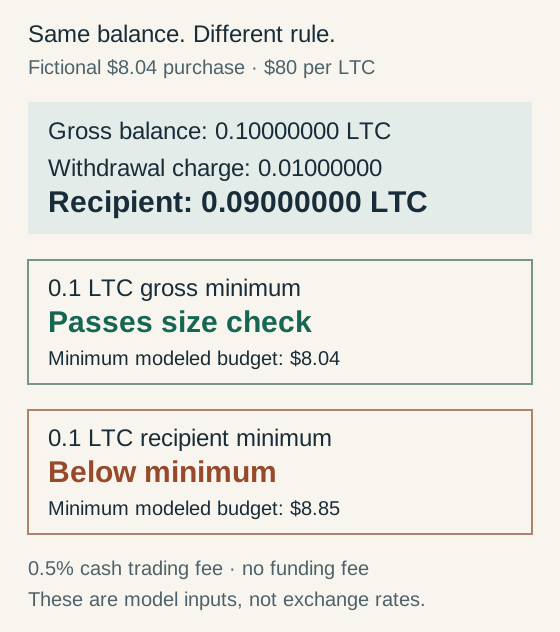
The phrase “minimum 0.1 LTC” leaves an important question: is that the amount debited from your account, including the charge, or the amount that must reach the recipient? In our model, the withdrawal charge is deducted from the gross debit. We deliberately test both possible policies.

| Scenario | Budget | Minimum basis | Gross LTC required | Delivered LTC | Result |
|---|---|---|---|---|---|
| S06 | $8.04 | 0.1 LTC gross | 0.10000000 | 0.09000000 | Passes size checks |
| S07 | $8.04 | 0.1 LTC delivered | 0.11000000 | 0; withdrawal fails | Below minimum |
| S08 | $8.85 | 0.1 LTC delivered | 0.11000000 | 0.10007462 | Passes size checks |
All three rows use a 0.01 LTC withdrawal charge and 0.5% cash trading fee. To deliver at least 0.1 LTC, you need a gross balance of 0.11 LTC. At our assumed price, the unrounded cash threshold is 0.11 × 80 × 1.005 = $8.844. A cent-denominated budget must round up to $8.85.
These are chosen definitions, not claims about Kraken or Coinbase. Read whether the provider adds the charge to the entered amount or subtracts it. The decisive fields are gross debit, fee and recipient amount, even when the button displays only “Send.”
A sufficient balance can still be unavailable
Funding restrictions are a separate check. Kraken's hold documentation describes restrictions associated with some funding methods and account actions, while trading can remain possible. Coinbase similarly explains that crypto bought with held cash can be traded but cannot be sent until the hold is lifted. Inspect the availability shown for your transaction.
| Scenario | LTC bought | LTC held | LTC available | Delivered LTC |
|---|---|---|---|---|
| S10: full hold | 0.12437810 | 0.12437810 | 0.00000000 | 0; held |
| S11: partial hold | 0.12437810 | 0.09000000 | 0.03437810 | 0; below minimum |
| S12: hold released | 0.12437810 | 0.00000000 | 0.12437810 | 0.12337810 |
The model uses fixed LTC hold amounts for clarity. A provider may calculate restrictions using a fiat value or other account rules. We did not reproduce its internal system. Releasing the synthetic hold changes withdrawal eligibility without adding coins; the price and charges are kept unchanged.
Do not assume that buying more unlocks the held purchase. Check the stated release and any separate restriction. Coinbase's account-limits documentation also explains that limits depend on account circumstances and payment type. A successful earlier purchase is not proof of today's sending availability.
A test withdrawal changes the remaining calculation
A small transfer can check whether a route reaches your own wallet or is credited by a service. It also consumes coins and can incur another withdrawal charge. Plan the test and the remainder together.
Take S02's 0.12437810 LTC balance. A 0.05 LTC gross test delivers 0.049 LTC after the 0.001 LTC charge. The remaining 0.07437810 LTC exceeds our chosen gross minimum and a second withdrawal could deliver 0.07337810 LTC. Total received: 0.12237810 LTC, compared with 0.12337810 from one withdrawal. The extra deduction is 0.001 LTC, worth $0.08 at the assumed execution price.
For S01's $5 purchase, the same test leaves 0.01218905 LTC on the exchange. That remainder falls below the 0.05 LTC withdrawal minimum. Only 0.049 LTC has reached the wallet; the remainder has not disappeared, but the modeled second withdrawal is unavailable.
At a receiving exchange, check its deposit minimum against the net test receipt, not just the amount you enter at the source. A confirmed output below a service's credit threshold may not demonstrate the usable route you wanted to test.
Save the final preview and check the actual receipt
Before confirming, preserve the product, quote time, cash debit, expected LTC credit, selected network, gross withdrawal, fee and net recipient amount. Check the full destination through its trusted wallet display or current deposit instructions. Record any hold and the available balance.
If the preview fails, identify which rule failed before changing the plan. Compare supported purchase routes, reconsider the amount or wait for the stated hold; do not treat extra funding as an automatic fix. The LTC calculator supplies a reference conversion, not an authenticated withdrawal permission.
After submitting a withdrawal, distinguish the provider's internal request from a blockchain transaction. When an actual TXID is available, use our transaction checker to inspect the transparent recipient output and confirmation state. A confirmed output does not prove an exchange has credited an internal account. Keep the receiving service's record separately. If you need to contact it, our payment-support guide helps you select the relevant evidence without exposing wallet secrets.
Download the model and the beginner checklist
The source record identifies the reviewed documentation; the artwork record identifies the conceptual hero and diagram. The release contains all twelve declared inputs, complete scenario results, both split tests and machine-readable results. Download the Python calculation and inputs into one folder, then run python analyze.py.txt .. It uses only the standard library.
124 assertions passed. Checks independently reconstruct quantities with exact rational arithmetic, reconcile cash and LTC, and test the chosen minimum definitions. The method and exclusions explain rounding, fee conventions and unavailable withdrawals; checksums identify the files.
Keep the blank CSV checklist or plain-text checklist locally. Neither needs a seed, private key, password or API key. Public addresses and TXIDs can reveal payment activity if shared.
This model excludes real order-book depth, partial fills, platform cash rounding, additional lot increments, percentage withdrawal charges and changing rules. Passing its checks establishes arithmetic eligibility under the declared policy. The authenticated account preview determines whether a real withdrawal can proceed. Research, code and drafting used AI assistance; no independent external review or funded-account test is claimed.