Yes. An ordinary Litecoin payment can be confirmed while the recipient's wallet software is stopped. The sender needs the correct receiving address. Your wallet needs updated chain information to discover and display the payment when it reconnects.
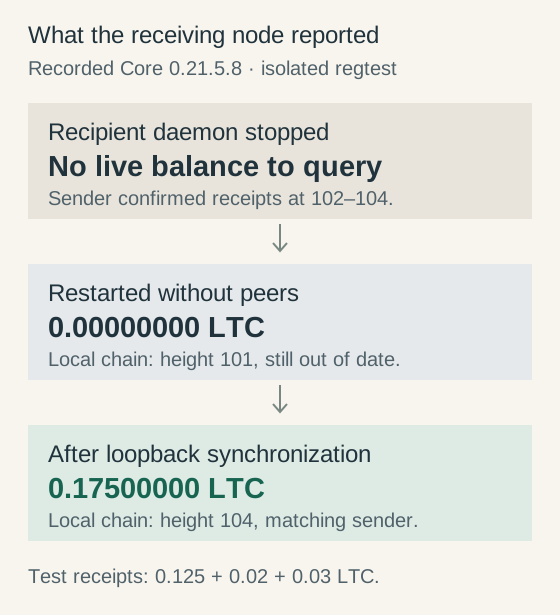
We tested that distinction with two fresh Litecoin Core nodes. After synchronizing both to block 101, we shut down the recipient process completely. The sender then paid three previously generated addresses and confirmed all three payments. Restarting the recipient without peers still produced a zero balance. Connecting it to the sender revealed the full 0.175 LTC.
The useful lesson concerns what a wallet knows. A zero shown by a disconnected wallet can be a correct description of its old view and an incomplete description of the current chain.
Measured 12 October 2026 with Litecoin Core 0.21.5.8 on an isolated regtest chain. All coins were valueless test coins. Both nodes used fresh disposable wallets and only loopback peer connections. We did not test a mobile app, hardware device, exchange deposit, MWEB receipt or mainnet confirmation time.
Receiving uses an address your wallet already controls
For the ordinary transparent outputs tested here, the sender creates an output that can later be spent using the recipient's signing keys. Your application records those keys and recognizes related transactions. It does not have to acknowledge each incoming output before a sender can create it.
Prepare the destination while you can check it properly. Generate the receiving address in the intended wallet and verify the full string through a trusted wallet or device display. Keep the relevant backup and recovery configuration separately. Merely having a copied address does not establish that you can recover its signing keys.
We generated three native SegWit addresses in the receiving Core wallet before shutting it down. Core reported that the wallet owned each address. Its pinned wallet RPC source defines the address-generation and receipt queries used in the experiment. That is a narrow software check, not a test of a particular phone's interface.
Ordinary self-custody addresses do not need an app to keep a web session alive. A checkout or exchange can attach its own changing instructions to an address, however. The wallet's ability to recognize an output and a company's agreement to credit it are separate questions.
Three payments confirmed while the recipient process was stopped
Our sender first generated 101 regtest blocks to obtain spendable test funding. The recipient synchronized to the same tip, with zero LTC. We then called Core's stop command and waited for its process to exit successfully. Before each payment, the test checked that the recipient process remained stopped.
The sender paid 0.125, 0.02 and 0.03 LTC to the prepared addresses. We generated one block after each payment. At sender height 104, the three recipient outputs totaled exactly 0.17500000 LTC.
| Payment | Recipient output | Included at height | Sender confirmations at 104 | Recipient confirmations after catch-up |
|---|---|---|---|---|
| P1 | 0.12500000 LTC | 102 | 3 | 3 |
| P2 | 0.02000000 LTC | 103 | 2 | 2 |
| P3 | 0.03000000 LTC | 104 | 1 | 1 |
These counts follow tip height − inclusion height + 1. The first payment had three confirmations because two later blocks followed its inclusion block. It did not need three acknowledgments from the recipient.
We decoded each signed transaction and checked the intended output, rather than relying only on the sender's negative wallet entry. A separate export verifier reads the output values from transaction bytes and reconstructs the transaction identifiers. It checks the recorded arithmetic; it does not independently validate signatures.
Regtest lets us generate blocks on demand. Nothing in this table measures how quickly a mainnet payment would be included or establishes a universally sufficient confirmation threshold.
Restarting the wallet alone did not update its balance
The recipient's next start used the same test data directory and wallet but no peer connection. Its chain remained at height 101 and its RPC balance remained 0.00000000 LTC. Its wallet also returned an unknown-transaction error for each of the three payment IDs.
We knew that was incomplete because the sender had already validated the payment blocks at heights 102–104. Opening the application had loaded the saved local state; it had not supplied the missing blocks.
| Stage | Sender height | Recipient height | Recipient RPC balance | Recipient peer count |
|---|---|---|---|---|
| Before shutdown | 101 | 101 | 0.00000000 LTC | 1 |
| Payments confirmed; recipient stopped | 104 | Not running | Not available | 0 |
| Restarted without peers | 104 | 101 | 0.00000000 LTC | 0 |
| After loopback catch-up | 104 | 104 | 0.17500000 LTC | 1 |
Finally, the recipient made one explicit connection to the sender at a loopback address. After catch-up, both nodes had the same best-block hash. The recipient's trusted balance and the independent sum of its three unspent receipts were both 0.175 LTC.
Core's chain-information RPC source identifies the locally validated block height. Its network RPC source defines the one-time manual connection and peer metadata we recorded. The test changed the recipient's information without sending another payment.

Check the payment before treating a stale zero as a verdict
If someone says they paid while your wallet was offline, ask for the actual transaction ID after broadcast. An exchange withdrawal request may still be waiting inside the sender's service. An internal reference number need not identify a blockchain transaction.
For a transparent mainnet transaction, inspect the destination output and full LTC amount through a known explorer or our transaction checker. Use the service directly instead of following an unfamiliar imitation-explorer link. Record the source and observation time.
| Observation | What it can mean | Useful next check |
|---|---|---|
| Offline wallet shows zero | The displayed view can predate the receipt | Wallet connection and last synchronized chain state |
| Sender has an internal withdrawal reference | The service may not have broadcast yet | Provider status and actual blockchain TXID |
| Confirmed output matches your destination | The chain records that output | Correct wallet/account discovery and any service-credit rules |
| Lookup does not find the TXID | Wrong network, delayed broadcast or a source problem remain possible | Sender details and another current validated source |
A matching output does not authenticate a payer's identity or establish an exchange's internal account credit. A stale source can also misreport the current confirmation depth. Keep the evidence tied to the question it actually answers.
Do not request a second payment solely because your disconnected screen has not changed. If the wallet is current and the receipt is still missing, follow the restored-wallet discovery guide. A wrong account, address type or incomplete discovery can need a different fix from reconnecting.
A receiving address and an invoice are different instructions
Our test used previously generated addresses in a self-custody wallet. It did not use a price quote, an invoice timer or a receiving exchange's accounting system. Those systems can add conditions that the blockchain does not enforce.
Before a new exchange deposit, open the service's current native-LTC deposit screen. Check the network, full destination, minimum deposit and supported features. An earlier successful deposit does not establish that a company still credits the same instructions automatically. Our receiving-address guide separates fresh self-custody addresses from service-managed destinations.
A saved payment QR can still contain a valid address after its business quote has expired. That does not promise fulfillment at the earlier exchange rate. Confirm the merchant's current payment terms before using an old screenshot. Our expired-invoice guide separates network receipt from the receiver’s decision to credit an order. The payment-QR guide explains what the encoded fields can and cannot establish.
Closing your browser does not tell a custodian's servers to stop. Conversely, keeping a browser open does not guarantee its deposit screen is current. Identify which component is offline: the signing device, the application, its data backend or a whole Core node.
Receiving offline does not test spending or recovery
After synchronization, our recipient wallet reported the received outputs and a trusted balance. We did not spend those outputs. This experiment therefore demonstrates receipt discovery in that wallet, not a successful recovery or a signing test on a hardware device.
A watch-only wallet can recognize incoming value without the private material needed to spend it. Our balance-but-cannot-send guide tests that distinction. Separately, backups must restore the intended signing access and account configuration; seeing an address on a screen is not enough.
Keeping a device offline also does not repair a previously exposed backup. If someone else has the relevant signing secrets, your application being closed does not remove their access. Receiving, checking the chain, protecting secrets and proving recovery are separate tasks.
These observations concern ordinary transparent Litecoin outputs. Wallet discovery, visibility and service support can differ for MWEB. We excluded it rather than treating the three native SegWit receipts as an interoperability test for every Litecoin feature.
Keep a short offline-receiving record
You do not need a live recipient application to arrange every self-custody receipt, but you do need a checked destination and a way to verify what happened later. The blank checklist keeps those steps together without collecting wallet secrets.
| When | Record | Check |
|---|---|---|
| Before going offline | Wallet, network and prepared destination | Full address belongs to the intended wallet; service instructions current if applicable |
| After sender broadcast | TXID, output amount and observation time | Exact destination and chain state through a known source |
| After reconnecting | Wallet discovery and synchronized state | Recognized amount and confirmations; internal credit checked separately |
Download the plain-text checklist or CSV version and keep account-specific notes locally. Seeds, private keys, wallet files, passwords and login cookies do not belong in it.
Public addresses and TXIDs can reveal payment relationships when shared. Include only the necessary payment details in a support request, through the actual service's authenticated channel.
Reproduce the test and inspect its limits
The release includes recorded states and 63 passing assertions, the three payment records, the state table and a RPC transcript. These are regtest addresses and identifiers. Do not use them as real receiving instructions or expect a mainnet explorer to find them.
The test script requires Python 3 and the Core 0.21.5.8 executables. It creates fresh temporary directories, never accepts a user's wallet, disables automatic peer discovery and binds RPC and P2P to loopback. Both created processes exited cleanly before their test directories were removed.
The separate export verifier passed 38 checks without running Core or accessing a network. It independently reads recipient amounts from signed transaction bytes, reconstructs TXIDs and checks the recorded timeline and confirmation arithmetic. It does not prove signatures or attest to the execution independently.
See the source record, method and reproduction commands and file checksums. Fresh runs generate different wallets, identifiers and timestamps. Research, code and drafting used AI assistance. No independent external review, mainnet timing measurement or mobile-app test is claimed.
The artwork record identifies the generated conceptual hero and original explanatory diagram.