Analysis

Does anyone actually pay with Litecoin in 2026? The real adoption data

TL;DR

LTC tops BitPay by transaction count and is its #1 payout coin since 2022. But stablecoins have won mainstream crypto payments. Here's the honest data.

Litecoin was designed in 2011 to do one thing well: move money fast and cheap. Fourteen years and zero downtime later, the fair question is whether anyone uses it for that. The honest answer in 2026 is split. On the dedicated crypto-payment rails that still exist, Litecoin is not a footnote — on BitPay it is the single most transacted coin by count. But the broader story is that those rails have shrunk in relevance, because dollar stablecoins captured almost everything that looks like a real payment economy. Both things are true at once, and most coverage only tells you one of them.

The one place where LTC genuinely wins: BitPay

The strongest data point for Litecoin-as-money comes from BitPay, the oldest large crypto payment processor. In May 2025 BitPay's VP of marketing Merrick Theobald confirmed that Litecoin had passed Bitcoin to become BitPay's most transacted cryptocurrency, accounting for over 40% of all transactions on the platform. His framing matters and is worth quoting precisely: "Litecoin is our most transacted cryptocurrency, by the number of transactions, not by revenue." Bitcoin still moves more dollar value per payment; Litecoin moves more payments.

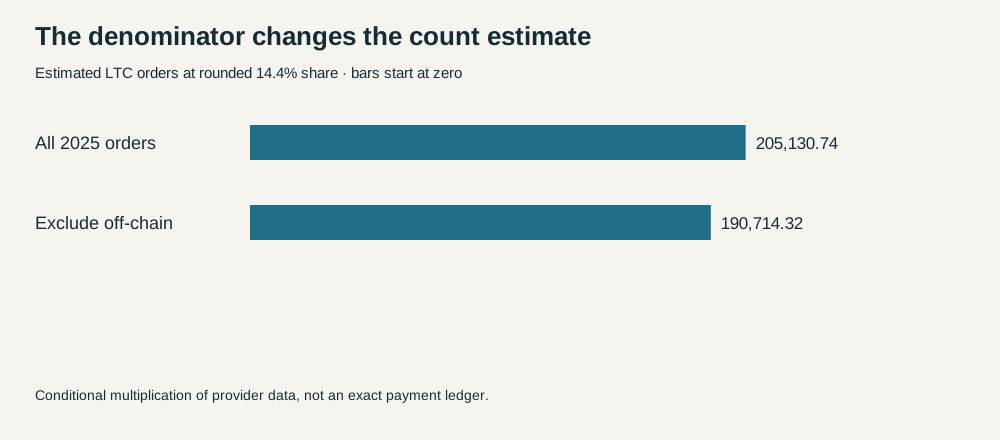
That is not a 2025 fluke. Litecoin has been BitPay's number-one payout coin since early 2022 — the coin merchants and platforms choose when they send money out, precisely because confirmations are quick and fees are trivial. In 2024 BitPay logged roughly 201,000 LTC transactions, ahead of Bitcoin's ~130,000, with Ethereum, Dogecoin and USDC trailing. CoinGate's 2025 figures tell a consistent story: LTC sat around 14.4% of all crypto payments processed, third overall and briefly second in mid-2025. The activity is concentrated in unglamorous, high-frequency categories — VPNs, web hosting, proxies, gaming, gift cards — where a sub-cent fee on a $30 checkout actually changes the unit economics.

So when someone tells you nobody pays with Litecoin, the BitPay and CoinGate numbers are the rebuttal. On the surviving merchant-payment rails, LTC is arguably the most used non-stablecoin coin on a per-transaction basis.

The much larger story: stablecoins already won

The problem with the bull case is the denominator. Branded merchant checkout — "pay with crypto at this store" — is a small and shrinking slice of what crypto payments actually are. The real money moved through stablecoins.

In 2025 stablecoins settled roughly $28 trillion in real economic volume, and facilitated an estimated $20–30 billion of on-chain payment transactions per day, split across remittances and settlement. B2B stablecoin payments alone ran near $226 billion for the year — about 60% of stablecoin payment volume — after growing more than 700% year over year (figures via Artemis and McKinsey; treat the exact splits as estimates, since on-chain measurement is noisy). The total stablecoin market cap now exceeds $240 billion, with Tether's USDT around 67% and Circle's USDC near 27%.

Then came the law. The US GENIUS Act, signed in July 2025, created a federal framework for dollar-backed payment stablecoins, and by late 2025 the OCC had conditionally granted trust-bank charters to Circle, Paxos and others. Regulatory clarity is exactly what corporate treasuries, payment processors and remittance firms were waiting for. The effect is a self-reinforcing flywheel: more legitimacy, more issuers, more integrations, more volume — none of which flows to Litecoin.

The tell is inside BitPay's own numbers. Stablecoins rose to 40% of BitPay payment volume in 2025, up from 30% in 2024. Litecoin wins the transaction count; stablecoins increasingly win the dollars. That gap is the whole argument in miniature.

Why merchants prefer a dollar token — and it isn't ideology

The reason is boring and decisive: a merchant priced in dollars wants to receive dollars. A $1 USDC is worth $1 at checkout and $1 at settlement. Litecoin can be worth one number when the invoice loads and a different number ten minutes later. Processors paper over this with instant auto-conversion — CoinGate reported that 73.5% of its LTC merchants auto-convert to EUR on receipt — but auto-conversion quietly concedes the point. If the first thing the merchant does is dump LTC for fiat, the coin is a transport layer, not a store of value in the transaction. A stablecoin skips the round trip.

The volatility tax nobody puts on the marketing page

Here is the friction that kills everyday LTC spending in practice, told straight. In late 2021 a developer I know paid a contractor about 5 LTC for a small job, around $1,000 at roughly $200 a coin. Convenient, instant, sub-cent fee — textbook Litecoin payment. The contractor, a believer, held the coins instead of converting. Within a year LTC had fallen toward $50; that same "$1,000" was worth a few hundred dollars. He had effectively taken a pay cut by accepting the asset he believed in.

Now flip it. In a tax jurisdiction like the US, spending appreciated LTC is a taxable disposal. Buy LTC at $60, spend it at $120 on a laptop, and you owe capital gains on the difference — for the privilege of buying a laptop. Every spend becomes a tax event you have to track. Stablecoins, pegged to the dollar, generate essentially no gain or loss to report. For an ordinary person, that paperwork asymmetry alone is enough to never spend LTC on coffee. The volatility tax cuts both directions: hold and you might get poorer, spend and you might owe the taxman.

LTC versus stablecoins versus BTC, head to head

PropertyLitecoin (LTC)Stablecoins (USDC/USDT)Bitcoin (BTC)
Typical confirmation~2.5 min block; fast in practiceSeconds to minutes (chain-dependent)~10 min block; slower
Typical feeSub-cent (often <$0.01)Cents to dollars (varies by chain)Cents to several dollars when busy
Price volatility at checkoutHighNone (dollar-pegged)High
Issuer / counterparty riskNone (no issuer)Yes — depends on issuer reservesNone (no issuer)
ChargebacksNoneNoneNone
Merchant acceptance trendNiche, steady on dedicated railsDominant and growing fastWide but value-skewed
Tax-on-spend friction (US)High (capital gains per spend)MinimalHigh (capital gains per spend)

What the on-chain data actually shows

Litecoin's chain is busy by its own standards — daily on-chain activity in 2026 has touched its highest levels since mid-2023, and MWEB, the optional confidential-transaction layer launched in 2022, now holds well over 400,000 LTC pegged in after a record run. MWEB even showed up as a real payment method: attendees paid for Litecoin Summit Amsterdam tickets via MWEB in June 2026. That is a genuine signal that some holders use the chain to move value privately and cheaply.

Read the figures soberly, though. A few hundred MWEB transactions a day is a community of enthusiasts, not a payment economy. Raw on-chain counts also blend speculation, exchange shuffling and self-transfers with actual commerce, so they overstate "payment" use. The cleanest evidence of real economic spending remains the processor data — BitPay and CoinGate — and that evidence says the same thing: meaningful, real, and small relative to dollars on stablecoin rails.

Risks and caveats

A few things could move this either direction. MWEB's privacy is a double-edged sword: in 2025 a zero-day exploit triggered a 13-block reorg on the network, a reminder that newer code carries risk and that some exchanges remain wary of confidential-transaction coins for compliance reasons. On the bull side, the same GENIUS Act clarity that boosts stablecoins could legitimize crypto payments broadly and lift LTC volume on the rails it already leads; an approved spot LTC ETF could pull in holders who later transact. And the central knock on stablecoins — issuer and reserve risk — is precisely the risk Litecoin does not have. No company can freeze your LTC or fail and break its peg. For users who weight censorship-resistance and zero counterparty risk above price stability, that is a real, if minority, value proposition.

The verdict

Yes, people pay with Litecoin in 2026 — more than skeptics assume, and on BitPay more than with any other single coin by transaction count. As a censorship-resistant, no-issuer, sub-cent payment rail with a 14-year uptime record, LTC does something stablecoins structurally cannot, and a dedicated merchant base genuinely uses it. But on the question of who won mainstream crypto payments, the answer is unambiguous and it is not Litecoin. Dollar stablecoins took remittances, B2B settlement and the bulk of payment value, and the GENIUS Act poured concrete over that lead. Litecoin's honest role in 2026 is a strong niche: the best non-stablecoin coin for low-value merchant payments, in a market where low-value merchant payments are no longer where the money is.

Frequently asked questions

Is Litecoin really BitPay's most-used coin?

By transaction count, yes. In May 2025 BitPay confirmed LTC had passed Bitcoin to become its most transacted coin, over 40% of platform transactions, and it has been BitPay's top payout coin since early 2022. By dollar value per payment, Bitcoin still leads, and stablecoins reached 40% of BitPay's payment volume in 2025.

Why do merchants prefer stablecoins over Litecoin?

Merchants price in fiat and want to receive a stable value. A $1 stablecoin is worth $1 at settlement; LTC can swing between invoice and confirmation. Most LTC merchants auto-convert to fiat immediately anyway (about 73.5% on CoinGate), which makes a dollar-pegged token the simpler choice.

Does spending Litecoin create a tax bill?

In jurisdictions like the US, yes. Spending LTC is treated as disposing of property, so any gain since you acquired it is a taxable event you must report — for every spend. Dollar stablecoins generate essentially no gain or loss, which removes that friction and is a major reason they dominate everyday payments.

What are Litecoin's genuine advantages for payments?

Fast ~2.5-minute blocks, typically sub-cent fees, no chargebacks, no issuer that can freeze or censor funds, and an unbroken 14-year operating record. For users who prioritize censorship-resistance and zero counterparty risk over price stability, those are real benefits stablecoins cannot match.

Is MWEB making Litecoin a serious payment network?

MWEB adds optional privacy and now holds over 400,000 LTC pegged in, with real-world use such as paying for Litecoin Summit tickets. But daily MWEB transaction counts remain in the hundreds — an enthusiast community, not a payment economy. It is a meaningful feature, not yet a mainstream-payments driver.

Jarosław Wasiński
Jarosław Wasiński
Editor-in-chief · Crypto, forex & macro market analyst

Independent analyst and practitioner with over 20 years of experience in the financial sector. Actively involved in forex and cryptocurrency markets since 2007, with a focus on fundamental analysis, OTC market structure, and disciplined capital risk management. Creator of MyBank.pl (est. 2004) and Litecoin.watch — platforms delivering reliable, data-driven financial content. Author of hundreds of in-depth market commentaries, structural analyses, and educational materials for crypto and forex traders.

20+ years in financial marketsActive forex & crypto trader since 2007Founder of MyBank.pl (2004) & Litecoin.watch (2014)Specialist in fundamental analysis & risk management

Track Litecoin in real time

Live rates for 30+ currencies, updated every second

Open dashboard