


Mimblewimble and Litecoin MWEB: How the Privacy Layer Works
A clear guide to MWEB commitments, range proofs, cut-through, entry and exit points, wallet support and practical privacy limits.
On this page
MimbleWimble allows certain transaction-validity checks to work without publishing ordinary transparent amounts. Litecoin implements an adapted design through optional MimbleWimble Extension Blocks, or MWEB.
Reviewed 18 September 2026. This guide explains the technical design and its limits. The separate MWEB usage guide covers wallet compatibility and practical operation.
The design goals are different properties
Confidential amounts, less directly exposed transaction structure and compact retained data are related but distinct goals. A system can improve one without making every other piece of information secret.
| Property | What to ask |
|---|---|
| Amount confidentiality | What values are hidden, and under which assumptions? |
| Transaction linkage | Which relationships can an observer infer? |
| Network privacy | Who can observe broadcast origin and timing? |
| Data reduction | What can be discarded while preserving validation? |
| Compatibility | Which wallets and services support the relevant route? |
A privacy claim should identify the observer. A public explorer, a network peer and a service holding a user's account history do not possess the same information.
Commitments let nodes work with hidden amounts
A simplified Pedersen commitment can be written as:
C = rG + vH
Here, v represents the amount, r is a blinding value, and G and H are curve points used by the construction. The actual implementation includes additional design details; this expression illustrates the central idea.
Commitments can be added and subtracted. This allows a verifier to check appropriately constructed balance relationships without being shown each ordinary amount. The blinding hides the value, while the binding property depends on the underlying cryptographic assumptions.
Commitments alone are not a complete transaction protocol. A validator must also check the permitted range of values, signatures and all other consensus conditions. “The commitments balance” is not a sufficient substitute for those checks.
The MWEB design proposal describes the integration and relevant primitives.
Why range proofs and kernels matter
A range proof demonstrates that a committed amount lies in the permitted range without revealing the amount itself. This prevents invalid arithmetic from being disguised inside hidden values. The Bulletproofs research paper provides the underlying research context for compact range proofs.
A kernel carries information used in validating the transaction's cryptographic balance and authorization, together with applicable public protocol fields. It should not be described as the sole visible object in an ordinary MWEB transfer.
Inputs, output commitments, associated proofs, kernels and other implementation-defined data remain relevant. Some information can later be compacted, but observers may have recorded earlier states.
| Component | Conceptual role |
|---|---|
| Commitment | Represents a hidden amount under the construction |
| Range proof | Supports verification that the amount is in range |
| Kernel and signature-related data | Support the required validity and balance checks |
| Inputs and outputs | Identify the state consumed and created |
| Public fields | Carry information that the protocol does not conceal |
This table is an explanatory model, not a byte-level serialization reference. Exact fields should be checked against the applicable code revision.
Cut-through: cancel intermediate state, retain evidence
Suppose one illustrative transfer creates an output O, and a later transfer spends that same output. In an aggregate representation, the matching intermediate output and input can be removed where the protocol's cut-through rules permit.
The retained state still needs the other information required to verify it. Kernels are not simply deleted because an intermediate output was spent.
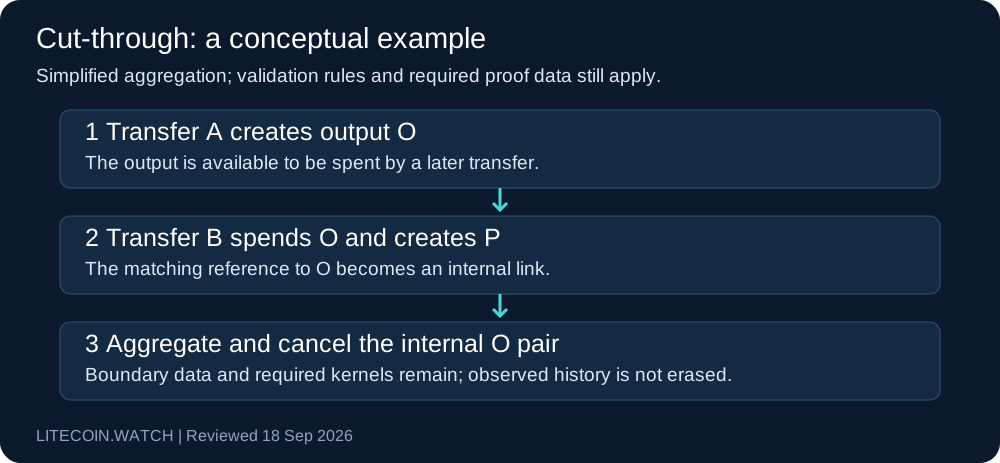
A useful analogy is simplifying an expression by cancelling equal terms. It does not mean nobody could have observed those terms before simplification.
The space saved depends on the transaction sequence, the number of outputs spent within the relevant aggregation and the retained proof material. An isolated example cannot establish a permanent “60% smaller blockchain” claim.
Non-interactive receiving is an implementation distinction
The original MimbleWimble family and Litecoin's deployed adaptations should not be treated as identical workflows. LIP-0004 describes non-interactive transaction features, including the receiving construction.
One-time receiving information reduces the exposure associated with repeatedly placing a conventional public address on-chain. It does not erase every possible association with a wallet, service or payment request.
A published address, merchant invoice, exchange account and observation of entry or exit can reveal information outside the cryptographic amount commitment. Users should not infer anonymity solely from an address format.
Extension blocks and the transparent boundary
MWEB runs alongside Litecoin's canonical blocks under its integrated validation design. It is not simply an unrelated external smart-contract bridge, and it does not make the transparent part of Litecoin disappear.
A peg-in moves value into the extension; a peg-out moves value back to a transparent destination. The integrating mechanism connects the accounting across that boundary.
| Route | What remains important |
|---|---|
| Transparent to MWEB | Entry information and receiving-wallet support |
| MWEB to MWEB | Confidential-transaction validation and wallet state |
| MWEB to transparent | Exit information and destination compatibility |
| Exchange or processor interaction | The service's records and supported deposit rules |
Older software that does not validate the extension should not be represented as performing all the same checks as an upgraded node. Compatibility and complete validation are different properties.
Network-level privacy is another layer
Transaction relay can reveal information independently of the transaction's amount fields. The Dandelion++ research studies a relay approach intended to make origin inference harder.
No relay mechanism should be presented as a guarantee against every observer. Peering, timing, active observation and information available to counterparties can matter. A claim about the confidentiality of amounts is narrower than a claim about hiding IP addresses.
Cut-through also cannot force an observer to delete a copy of data it already recorded.
Security and legal claims need their own evidence
The 2026 MWEB incident postmortem describes a validation exploit and a later disruption involving an invalid branch. An explanation of the cryptography must not be used to imply that implementations have never failed.
Follow Litecoin Core releases for relevant fixes. This article reviews documentation and design concepts; it does not audit a binary, verify a wallet's funds or certify a service's operating state.
Optional privacy does not automatically guarantee legal treatment or exchange availability in every country. Provider decisions and applicable rules can differ. Keep the transaction records needed for your circumstances even where an explorer cannot reconstruct them.
Evaluating an MWEB claim
Ask which property is claimed, which version implements it and which observer model is assumed. Check whether a reported adoption figure measures balance, transfers or people. Those are not interchangeable.
For wallet selection, use the wallet compatibility guide. For recovery, consult the storage guide; a generic exported key list should not be assumed to preserve every feature's required state.
Frequently asked questions
Does MWEB make all Litecoin transactions private?
No. It is optional, and transparent transfers remain part of Litecoin.
Are only transaction kernels visible?
No. Commitments, proofs, inputs, outputs and other protocol information also matter.
Does cut-through erase everything an observer may have seen?
No. It changes what can be retained for verification under the protocol, not what an observer already recorded.
Do zero-knowledge proofs alone guarantee a bug-free wallet?
No. Cryptographic primitives, implementation correctness and operational security are separate questions.



Track Litecoin in real time
Rates for 30+ currencies. Check each tool for its latest source timestamp.
Open dashboard