


Litecoin UTXOs and coin control: inputs, change, fees and privacy
Understand where Litecoin change goes, how input count affects fees, when consolidation can help and which privacy tradeoffs coin control introduces.
On this page
Reviewed 18 September 2026. This guide covers ordinary transparent Litecoin transactions. UI labels were checked against Litecoin Core v0.21.5.8 source files; menu placement can differ by operating system. Fee rates are illustrative, not current recommendations. The hero is an AI-generated conceptual illustration.
Your wallet displays “2 LTC”, but the blockchain does not necessarily contain one object worth 2 LTC. That balance could come from two outputs worth 1.2 and 0.8 LTC, twenty small receipts, or hundreds of mining payouts. Spending the same amount can therefore require different numbers of inputs and different fees.
Understanding unspent transaction outputs, or UTXOs, explains where change goes, why repeated small deposits affect future transactions, and what coin control can actually control. It also helps you avoid a costly misconception: combining everything into one output is not automatically a privacy improvement.
1. A UTXO is an output you have not spent
In a transparent transaction, an output records a value and a spending condition. A later input refers to that output using its previous transaction ID and output index. Litecoin Core represents this reference as an outpoint. The script determines how the output can be spent; the address is a convenient representation used when constructing certain scripts. Source: Litecoin Core transaction structures.
| Term | Meaning in this guide |
|---|---|
| UTXO | A transaction output not yet spent |
| Outpoint | A prior transaction ID plus the index identifying its output |
| Input | A reference to a prior output, with data needed to satisfy spending rules |
| Output | Value and a spending condition created by a transaction |
| Change | A new output returning value to the sender’s wallet |
| Wallet balance | A view aggregating relevant outputs; spendability depends on context |
| Coin control | Wallet controls for inspecting and choosing outputs used by a payment |
Receiving several payments to one address can create several UTXOs. Conversely, a wallet can control UTXOs associated with many addresses. A blockchain explorer's address balance, the wallet's total balance and the set currently available for spending answer different questions.
For example, a wallet can track a watch-only output without possessing the signing key. Another output may be temporarily unavailable under the wallet's confirmation, locking or transaction-selection rules. “I can see it” is not sufficient evidence that it can fund the transaction you are composing.
2. Follow one payment, including the change
Suppose you control two transparent outputs: 1.20000000 LTC and 0.80000000 LTC. You want the recipient to receive exactly 1.30000000 LTC. For this illustration, the completed transaction pays a fee of 0.00000418 LTC.
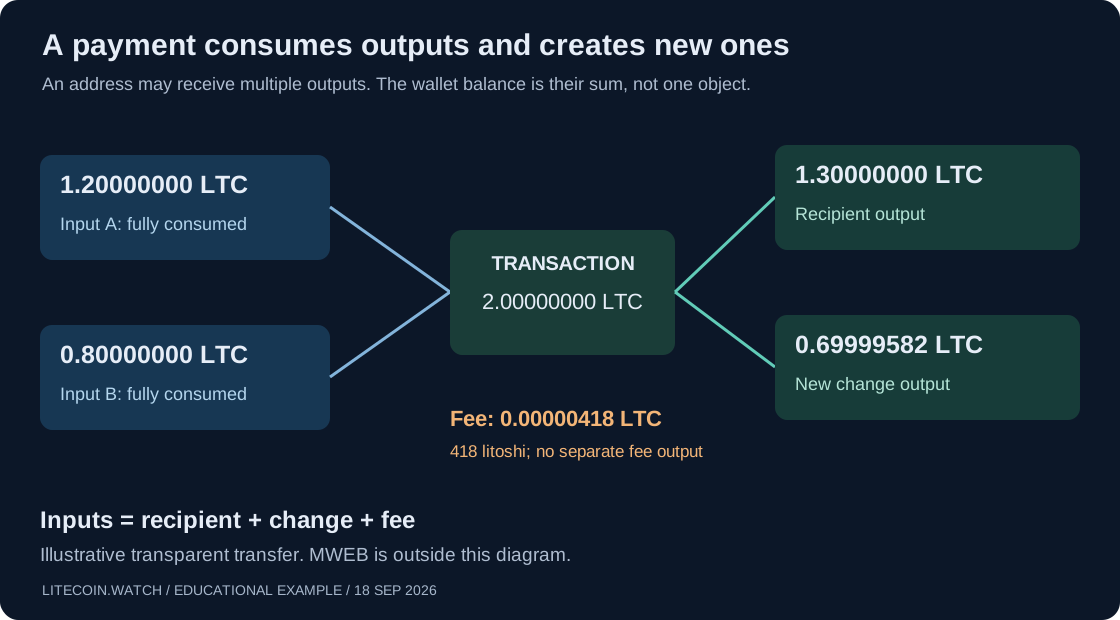
Inputs:       1.20000000 + 0.80000000 = 2.00000000 LTC
Recipient:                                  1.30000000 LTC
New change:                                 0.69999582 LTC
Fee:                                        0.00000418 LTC

2.00000000 = 1.30000000 + 0.69999582 + 0.00000418
Both selected inputs are consumed in full. The wallet does not trim a piece from one input and leave the old output partially unspent. It creates a new change output for the remainder. The network fee is the difference between input value and output value; it is not an extra payment output to a generic “miner address”. This input/output model is described in the Bitcoin developer transaction guide and is reflected in Litecoin's transparent transaction structures.
The recipient sees 1.3 LTC, while your spendable balance falls by 1.30000418 LTC. A transaction history that lists the full 2 LTC of inputs has not demonstrated that 2 LTC was paid to somebody else. Check the outputs, identify change cautiously, and separate the transfer amount from the fee.
A wallet normally manages its own change destination. Do not paste an address from an exchange deposit screen into a custom change field simply because it is familiar. Change is part of your payment construction and needs a destination you intend and can use. When using a hardware signer, review the transaction on its trusted display according to the device's instructions.
3. Why input count affects fees
A transaction containing more inputs usually requires more serialized data and signatures. For SegWit transactions, virtual size is the transaction's weight divided by four, rounded up. A byte and a virtual byte are therefore not interchangeable terms. Source: BIP 141 size definitions.
To make the relationship visible, use this approximate model for standard native SegWit P2WPKH inputs and outputs:
Estimated vbytes = ceil(10.5 + 68 × inputs + 31 × outputs)
Fee in litoshi    = estimated vbytes × fee rate in litoshi/vB
Fee in LTC       = fee in litoshi ÷ 100,000,000
The model assumes small input/output counts with ordinary compact-size fields and approximately 68 virtual bytes per input. Actual signatures can alter the exact weight. It is an educational estimate, not a promise about your wallet's final signed transaction. Multisig, legacy scripts, different output types and MWEB require different calculations.
| Inputs | Estimated size | Fee in litoshi | Fee in LTC |
|---|---|---|---|
| 1 | 141 vB | 282 | 0.00000282 |
| 2 | 209 vB | 418 | 0.00000418 |
| 5 | 413 vB | 826 | 0.00000826 |
| 10 | 753 vB | 1506 | 0.00001506 |
| 20 | 1433 vB | 2866 | 0.00002866 |
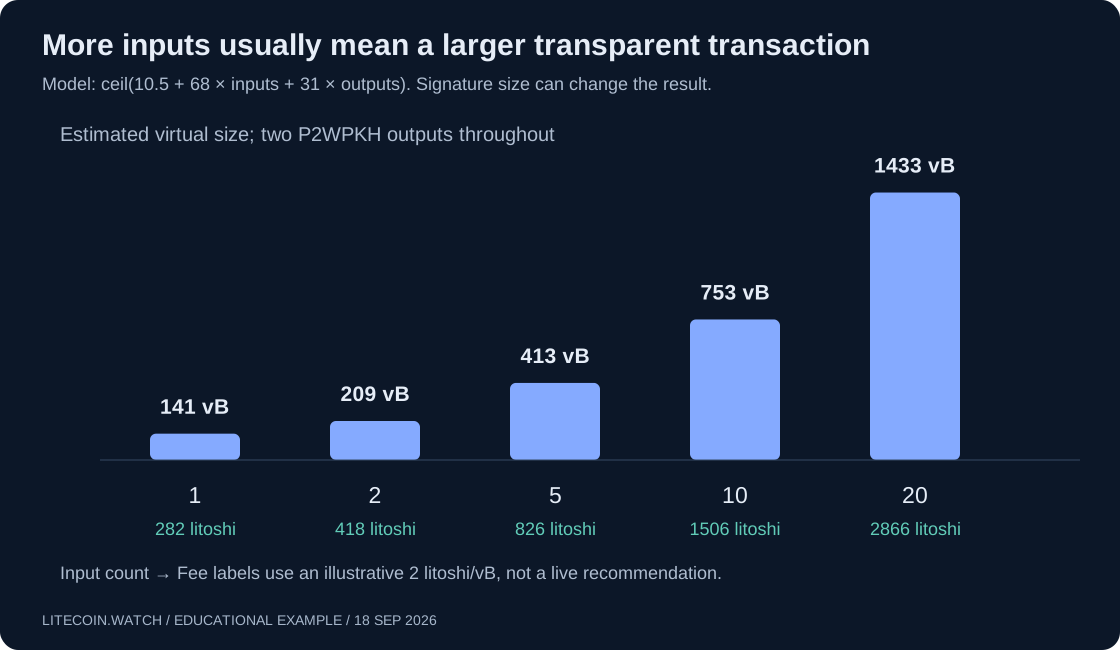
Every row uses two outputs and a hypothetical 2 litoshi/vB. A one-input transfer can therefore be cheaper than a ten-input transfer even when both send exactly the same LTC amount. The $ value of a payment does not directly determine its transaction size.
The two-input model gives 209 vB. At 2 litoshi/vB, that is 418 litoshi, matching the illustrative fee in the earlier diagram. The diagram's accounting identity is exact; the size assumption is an estimate. Keep those two claims separate.
Use the live fee page and the wallet's own transaction preview for current context. A relay-policy minimum is not a guaranteed next-block price, and an exchange's fixed withdrawal charge is not necessarily the network fee of the transaction containing your withdrawal.
4. What coin control changes
Coin control lets you inspect and influence which spendable outputs fund a payment. It can be useful when you want to keep labeled groups separate, avoid a particular output, or understand why a transaction contains so many inputs. It does not modify consensus rules, make spent outputs usable again or conceal a transparent transaction.
Automatic selection is a reasonable starting point for many users. Manual selection adds decisions: the chosen outputs must cover the payment and fee, may create change, and may reveal relationships between previously separate receipts. Selecting the smallest number of inputs is only one objective; it is not a complete privacy policy.
Inspecting coin control in Litecoin Core
- Use an up-to-date, authenticated Litecoin Core installation and the intended wallet. Confirm that your backup and recovery procedure are appropriate before making a real payment.
- In the Options/Preferences dialog, open the Wallet tab and enable coin control features. This wording is present in the v0.21.5.8 UI definition.
- Open the Send view and choose Inputs.... Review the available outputs and your labels.
- Select only the outputs you intend to use. Inspect the quantity, total input value, estimated size, fee and change.
- Review the recipient, amount and change behavior before authorizing. Recheck the final signed transaction if the wallet updates the estimate.
These steps are checked against the Options UI and Send UI, rather than presented as screenshots from every operating system.
Core's coin-control dialog also offers Lock unspent and Unlock unspent. These are wallet-selection controls, not an on-chain freeze. They do not stop another signer with the relevant keys from spending. Check whether your wallet preserves such selections or locks across restarts before relying on them. Source: coin-control dialog implementation.
5. Consolidation: compare two complete paths
Consolidation means spending several outputs into a smaller number of outputs you control. It costs a fee now. It may reduce a later payment's input count, but only if those outputs would otherwise have been needed for that later payment.
Consider ten P2WPKH inputs which you will later spend together. Keep the same approximate size model and compare two paths:
| Path | Size assumptions | Total modeled fee |
|---|---|---|
| Wait and spend ten inputs later | One transaction: 753 vB × 2 | 1,506 litoshi |
| Consolidate now, then spend later | 722 vB × 1, plus 141 vB × 2 | 1,004 litoshi |
| Difference under these assumptions | 1,506 − 1,004 | 502 litoshi (0.00000502 LTC) |
The hypothetical saving is 502 litoshi. It depends on both fee rates and the assumed future spend. Algebraically, consolidation saves fees in this model only when:
722 × current fee rate + 141 × future fee rate
  < 753 × future fee rate

future fee rate > (722 ÷ 612) × current fee rate
                > about 1.180 × current fee rate
This is not a recommendation to consolidate whenever that ratio appears favorable. Future fee rates are unknown, outputs may be spent separately, script types may differ, and there is an immediate privacy cost if unrelated receipts are combined. Very small nominal savings may not justify an extra operational step.
6. Coin selection is also a privacy decision
Transparent transactions expose the inputs spent together. Analysts can treat common-input spending as a clue that outputs share control, but that is a heuristic, not proof of one person's identity. Collaborative transactions and custodial systems complicate the inference.
Imagine one receipt from a publicly identified business and another from an unrelated personal activity. Combining them may disclose a connection that keeping them separate would not have revealed through that particular transaction. Sending the resulting change to a fresh address does not erase the already published input relationship. The general risks of address reuse and public transaction linkage are explained in Bitcoin.org's privacy guidance; here the discussion is limited to the analogous transparent Litecoin transaction model.
| Situation | Potential benefit | Tradeoff to examine |
|---|---|---|
| Many small receipts | Fewer future inputs after consolidation | An extra fee now; assumptions about the future spend |
| Receipts from different activities | Keeping groups separate can avoid one new public link | A suitable subset must still cover amount plus fee |
| Unknown small incoming payment | Excluding it can preserve separation | Wallet locks are local controls, not consensus rules |
| A very large payment | Combining enough value enables payment | Input count, change, and public linkage may grow |
| Automatic selection looks unexpected | Inspection can explain the wallet’s choice | Manual changes can make size or privacy worse |
Maintain useful local labels for where receipts came from, and avoid posting wallet screenshots that reveal balances or addresses unnecessarily. Labels are your records, not a cryptographic privacy feature. Coin control also does not hide network-level information; see the separate Tor guide for that layer.
7. Small outputs, dust and suspicious receipts
“Dust” is not one universal LTC amount. Relay policy considers the output's script and an assumed future spending cost. Litecoin Core's dust calculation depends on the configured fee-rate input and distinguishes output types. Do not copy a Bitcoin dust number into a Litecoin wallet checklist without checking the relevant policy. Source: Litecoin Core dust-policy calculation.
A small output can also be uneconomic to spend at a particular market fee rate even when it is accepted by the network's policy. These are related but different tests: policy acceptability does not guarantee economic usefulness.
Receiving an unsolicited tiny payment does not, by itself, disclose your private key. The concern can be later linkage or a scam designed to make you interact with a fake service. Do not follow instructions embedded in unsolicited transaction messages, and do not send a “verification payment” to unlock the receipt. If your wallet supports it, leaving an identified suspicious output out of automatic spending can help preserve separation while you investigate. See our existing dusting and address-poisoning guide.
8. What changes with MWEB?
MWEB is not simply a transparent transaction with its amounts hidden in the same public fields. Litecoin Core distinguishes ordinary outpoints from MWEB output identifiers and has separate MWEB structures. The public input/output amounts and P2WPKH size formula in this guide must not be applied to MWEB transfers. Source: Core's canonical/MWEB input and output types.
Use the wallet's specific MWEB workflow and fee quote, check compatibility at both ends, and consult the MWEB learning path. Optional amount confidentiality does not make every deposit route compatible or erase all operational privacy risks.
9. A checklist before authorizing a payment
- Purpose: Are you paying someone, moving funds between your wallets, or consolidating?
- Inputs: Do you recognize the selected outputs and accept the relationships their joint spending reveals?
- Coverage: Do inputs cover the intended recipient amount and fee?
- Change: Is any remainder going to a wallet-controlled destination you intend?
- Size and fee: Are you reading litoshi/vB, total litoshi and total LTC correctly?
- Authorization: Does the final wallet or signer display match the payment you planned?
- Verification: After broadcasting, check the transaction record and confirmations rather than relying on a copied “sent” message.
The wallet-security learning path covers recovery and address checks. For balance and cost planning, use the calculator and fee tracker; neither can choose private wallet inputs on your behalf.
Frequently asked questions
Can one address contain several UTXOs?
Yes. Separate payments can create separate outputs with spending conditions associated with the same address. Address count is not input count.
Is change an extra charge?
No. Change is value returned to an output you control. The fee is the input total minus the output total for the ordinary transparent transaction discussed here.
Should I consolidate all my LTC?
There is no universal rule. Model the additional transaction, possible later savings and privacy consequences. The numerical example assumes a particular future spend and does not predict fee rates.
Reproducibility and sources
Download the input-count and fee-model CSV. The SVG figures use these stated assumptions and contain no live blockchain claims. The technical references are the pinned Litecoin Core v0.21.5.8 source files linked above, the BIP 141 size definition and the developer documentation for the shared transparent transaction model. No mainnet transaction was sent to produce the examples, and the article does not claim a hands-on test of every wallet's UI.



Track Litecoin in real time
Rates for 30+ currencies. Check each tool for its latest source timestamp.
Open dashboard