
One 0.2 LTC fee changed the picture in our 144-block sample
We checked 144 mainnet blocks. One 0.2 LTC fee supplied 9.74% of all sampled fees, while the same block had a 427-litoshi RPC median. Inspect the accounting, outlier effect and fee-selection checklist.

Sources, review record & reproducibility
Downloadable data or code · Observed data / replay.
Content review recorded: 2026-10-04. The review record does not identify a separate independent reviewer. An edited date above records an edit, not a new fact-check.
Next scheduled review: 2027-01-02.
Sources saved with the review:
- raw.githubusercontent.com · /litecoin-project/litecoin/v0.21.5.8/src/rpc/mining.cpp
- raw.githubusercontent.com · /litecoin-project/litecoin/v0.21.5.8/src/rpc/blockchain.cpp
- raw.githubusercontent.com · /litecoin-project/litecoin/v0.21.5.8/src/chain.cpp
- raw.githubusercontent.com · /litecoin-project/litecoin/v0.21.5.8/src/chain.h
- raw.githubusercontent.com · /litecoin-project/litecoin/v0.21.5.8/src/arith_uint256.cpp
- raw.githubusercontent.com · /litecoin-project/litecoin/v0.21.5.8/src/chainparams.cpp
- raw.githubusercontent.com · /litecoin-project/litecoin/v0.21.5.8/src/validation.cpp
- raw.githubusercontent.com · /litecoin-project/litecoin/v0.21.5.8/src/validation.h
- raw.githubusercontent.com · /litecoin-project/litecoin/v0.21.5.8/src/pow.cpp
- raw.githubusercontent.com · /litecoin-project/litecoin/v0.21.5.8/src/consensus/params.h
- raw.githubusercontent.com · /litecoin-project/litecoin/v0.21.5.8/src/mweb/mweb_node.cpp
- litecoin.watch · /uploads/research/network-analyses-20261004-v1/README.txt
See the article body for source links and any downloadable materials. Editorial method · Corrections · Report an issue
On this page
One transaction fee of 0.2 LTC accounted for 9.74% of all fees in the 144 blocks we examined. In its block, the RPC median fee was just 427 litoshis, or 0.00000427 LTC. Both figures are correct. They answer different questions.
Our read-only Litecoin Core capture found 2.05386366 LTC in fees beside 900 LTC of scheduled subsidy. We reconciled those amounts with the actual coinbase outputs, separated the public MWEB kernel fees and tested how much that single large fee affected the average. The result gives beginners a practical way to read fee statistics without copying an outlier into their next payment.
Observation date: captured on 3 October 2026, 23:12:19–23:12:47 UTC; release date 4 October in Europe/Warsaw. This is a frozen network observation, not a live recommendation.
What we measured, and which period it covers
The fee sample contains every block from height 3,188,896 through 3,189,039, inclusive. We used one synced, pruned Litecoin Core 0.21.5.8 node. The final height and hash form the study boundary; we rechecked the captured heights against the active chain after collection.
The first and last block headers carry times of 17:47:08 and 23:09:17 UTC on 3 October. Their difference is 5 hours, 22 minutes and 9 seconds. Those are miner-declared header times. They are not when our node first saw the blocks, nor a record of how long any customer waited.
There are no missing heights inside this range. That makes the totals reproducible for the selected sample. It does not make a little over five hours representative of a day, month or future subsidy era. A 144-block window is approximately six hours at the 150-second target interval; actual production varies.
The underlying block observations and one-row-per-block CSV let you change the reporting window or check an individual result.
Fees supplied 0.228% of the available LTC reward
For each block, we added the protocol subsidy to the RPC fee total and compared that allowance with the sum of its coinbase outputs. All 144 sampled blocks claimed the full allowance. The fees were transferred from transaction inputs; the subsidy was the newly issuable amount.
| Measure | Observed amount | How to read it |
|---|---|---|
| Scheduled subsidy | 900 LTC | 144 × 6.25 LTC |
| All transaction fees | 2.05386366 LTC | Sum of the 144 RPC fee totals |
| Available coinbase reward | 902.05386366 LTC | Subsidy plus fees |
| Claimed coinbase outputs | 902.05386366 LTC | Same total in this sample |
| Unclaimed allowance | 0 LTC | Full allowance claimed in 144 of 144 blocks |
| Fee share of available reward | 0.227687% | Fees ÷ (subsidy + fees), rounded |
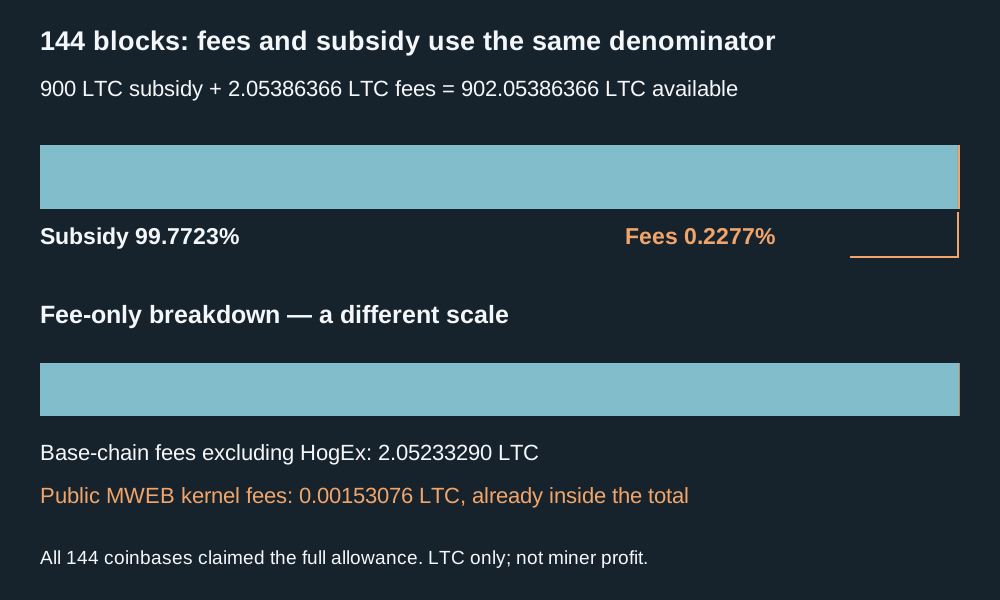
Equality is an observation here, not a rule requiring miners to take everything. Core rejects a coinbase that pays more than the allowed reward; paying less is possible. Keeping claimed and available amounts separate avoids turning that upper limit into an assumed issuance total.
The highest-fee block was dominated by one entry
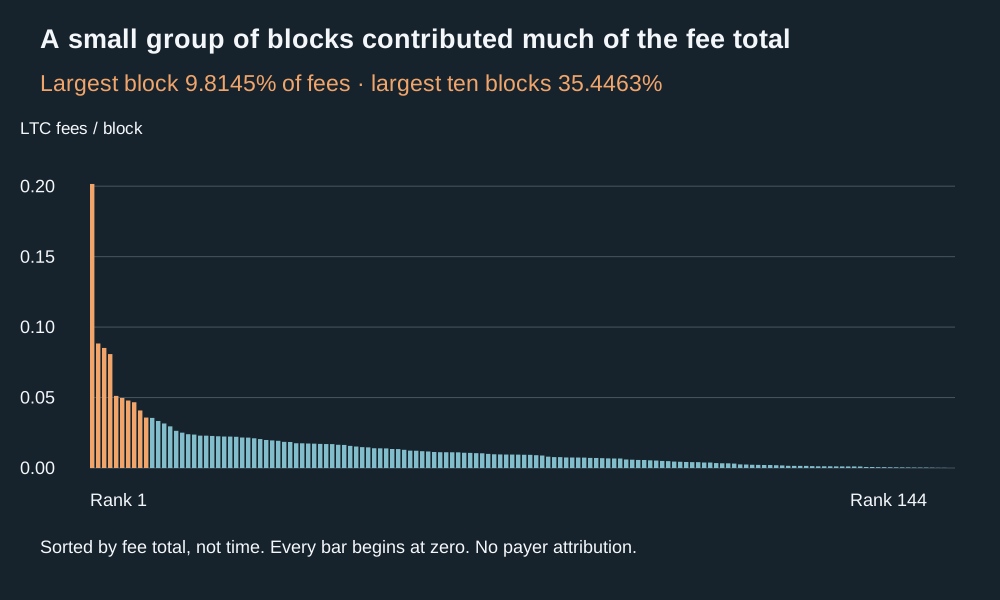
Block 3,189,026 contained 0.20157609 LTC in fees. Its maximum non-coinbase entry fee was exactly 0.2 LTC. There were no MWEB kernel fees in that block. Since the entire fee total was below 0.4 LTC, two entries could not both have paid 0.2 LTC. This establishes one maximum-fee entry without needing to identify its sender.
| Measure | Value | Interpretation |
|---|---|---|
| Total block fees | 0.20157609 LTC | 9.8145% of sample fees |
| Maximum entry fee | 0.2 LTC | 99.2181% of that block's fees |
| Fees from the other entries | 0.00157609 LTC | Total minus the maximum |
| Base-chain entries | 41 | Coinbase and HogEx excluded |
| RPC median fee | 427 litoshis | Includes HogEx among non-coinbase entries |
| Public MWEB kernel fees | 0 LTC | No MWEB fee contribution in this block |
We did not reconstruct the transaction ID, its owner, purpose or software settings. A large fee does not by itself establish a mistake, a special commercial payment or network congestion. Those explanations would require additional evidence.
The concentration also matters at block level: the ten highest-fee blocks, out of 144, supplied 35.4463% of all sampled fees. The largest block was 14.13 times the mean block total and 21.34 times the median block total. Treating that block as “typical” would substantially exaggerate the fees in this window.
Why “the average Litecoin fee” needs a denominator
We counted 44,490 base-chain entries reported by the RPC. That included 144 coinbases and 144 HogEx transactions. Removing both leaves 44,202 base-chain transactions. This count can include peg-ins and other activity; it is not a count of unique users or purchases. Separately, the extension blocks contained 50 public MWEB kernels.
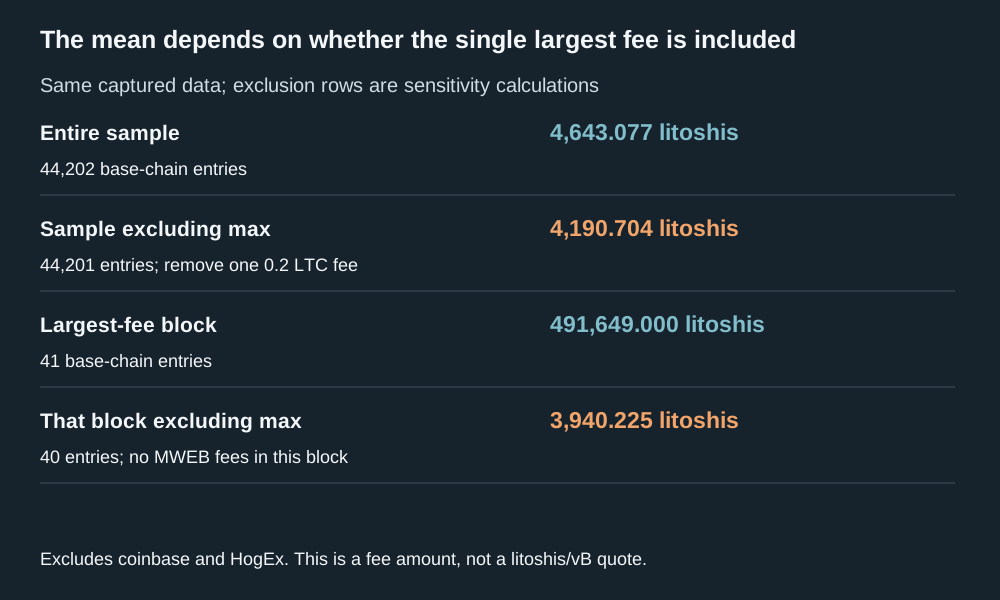
Our base-chain mean divides fees excluding HogEx by entries excluding coinbase and HogEx. The calculation is 2.0523329 LTC ÷ 44,202, giving approximately 4,643.08 litoshis per entry. We add numerators and denominators across blocks before dividing; averaging the individual block averages would give small and large blocks equal influence.
| Statistic | Litoshis | Denominator or boundary |
|---|---|---|
| Whole-sample base-chain mean | 4,643.08 | 44,202 entries; MWEB/HogEx fees excluded |
| Mean after removing the 0.2 LTC entry | 4,190.70 | 44,201 entries; sensitivity calculation |
| Largest block's base-chain mean | 491,649 | 41 entries in that block |
| That block's other-entry mean | 3,940.225 | Its remaining 40 entries |
| Largest block's RPC median fee | 427 | 42 non-coinbase entries, including HogEx |
Removing the single entry lowers the whole-sample base-chain mean by 9.743%. This is a sensitivity check: an outlier influenced the summary. It is not a recommendation to delete inconvenient observations. The full total remains the correct accounting of what those blocks contained.
The RPC implementation includes HogEx in its non-coinbase fee statistics. Its fee-rate percentiles are weighted by transaction weight, rather than one equal vote per transaction. Rates use integer units. A median of block medians cannot recover the global transaction median. We therefore report neither that shortcut nor a claimed global “typical customer fee.”
MWEB fees are part of the total, not an extra reward
The public MWEB kernels contained 0.00153076 LTC in fees, or 0.07453% of the sample's entire fee total. These are fee fields; they do not reveal the confidential transaction amounts or owners.
HogEx is the base-chain transaction connecting the extension block to the preceding state and peg-ins and peg-outs. The MWEB accounting check requires its fee to equal the extension block's total fee. The RPC already counts that HogEx fee.
Our reconciliation is therefore 2.0523329 LTC of base-chain fees + 0.00153076 LTC of MWEB fees = 2.05386366 LTC. Adding the kernel total to the RPC total would double-count it. Public kernel counts also cannot simply be appended to the base-chain count and labelled “payments.”
The companion hashrate-window analysis uses the same final block and shows why a reward table and a network rate are separate measurements.
What this says about mining, and what it does not
For this selected period, Litecoin coinbase allowances were overwhelmingly subsidy-funded. That is a measured composition of LTC rewards. It is not a calculation of an operator's profit or the spending needed to attack the network.
We did not collect Dogecoin rewards, pool payouts, electricity bills, hardware costs, market prices or other merged-mining income. An operator may earn revenue on another chain; that revenue does not become a Litecoin transaction fee. Converting this table into dollars would need a stated price and timestamp, while calculating profit would require costs and the operator's actual share of rewards.
Our earlier subsidy revenue model shows why assumptions matter. This study supplies a short observed fee window alongside that model. Neither supports a prediction that present fees will fund a particular future level of mining. The guide to the eventual zero-subsidy boundary separates calculable block heights from uncertain long-range economics.
How to choose a fee for your next payment
Do not enter 0.2 LTC or the sample's mean fee just because it appears in this article. A historical included fee describes one transaction's construction and circumstances. Your transaction can use a different number of inputs, outputs and virtual bytes, under different current conditions.
| Your situation | Check before acting | Useful next step |
|---|---|---|
| Sending from your own wallet | Current fee rate, virtual size, total fee and recipient amount | Use the wallet preview and our fee calculator |
| Withdrawing from an exchange | The service's withdrawal charge, chosen network and net amount received | Read the exchange confirmation screen; its charge need not match the transaction fee |
| Payment waiting for confirmation | Transaction ID, confirmation status and whether it is visible | Start with the transaction checker |
| Fee looks unusually large | Total fee versus fee rate, input count and units | Pause before signing and inspect the transaction preview |
First separate a total from a rate: LTC per transaction is not litoshis per virtual byte. Then inspect how many inputs the wallet consumes. Finally compare the quoted rate with a current recommendation whose source time is visible. The calculator's editable example and this article's observed average are not substitutes for that check.
Once broadcast, a payment's timing also depends on block production and other conditions. An expensive fee alone is not a delivery guarantee. Our node confirmation study explains the difference between local observations, successful confirmations and transactions still waiting.
Reproduce the results or inspect a different block
Download the research package and verify it against SHA256SUMS.txt. The README documents the schema and commands. Results JSON retains more precision than the rounded tables.
The public offline analyzer recomputes totals from the frozen files. Across the joint fee and hashrate package, it passed 2,223 assertions covering input hashes, chain continuity, accounting bounds and reconstructed calculations. Those checks help catch inconsistent data or arithmetic; they are not an independent review or proof that this sample represents other periods.
The separate capture script documents the read-only RPC collection. Replaying the offline package does not require a wallet, an account or sending any funds. A fresh capture requires your own appropriate Core node and produces different observations. Keep the original files when making comparisons. For everyday use, download the fee-reading checklist.
Sources, review record and limits
Primary code references were checked against the pinned Litecoin Core v0.21.5.8 source: block statistics, reward validation and MWEB accounting. No transaction owner, motive or economic payment volume was inferred.
This is original analysis of one read-only capture from one pruned node. Header times are not receipt times. The dataset is fixed at its recorded boundary, can be checked against another node and does not update with this page. AI assisted the drafting and analysis workflow; the public code, observations and checks support the stated calculations. No separate independent reviewer is recorded. The responsible editor is identified in the byline. Corrections should identify the block, field or calculation so they can be reproduced.



Track Litecoin in real time
Rates for 30+ currencies. Check each tool for its latest source timestamp.
Open dashboard