
Litecoin articles
Guides, news and research from the Litecoin.watch archive.
Topics group the whole archive; an article can cover more than one. For a suggested reading order, explore the learning paths.

A Litecoin timelock does not send the payment for you
A future-dated ordinary transaction did not reserve its input in our Core test. Compare that result with a required CLTV path, block-height rules and the chain's median clock before relying on a scheduled payment.
Data / code included
A 7 bp Litecoin spread hid a 231 bp cost in our €10,000 replay
A narrow spread does not tell you the cost of a whole order. In one saved LTC/EUR book, a €10,000 buy replay reached 2.31% above the midpoint. Our initial sample shows how amount and direction changed visible costs.
Data / code included
Why Litecoin hashrate estimates disagree at the same block
The same ending block produced hashrate estimates 16.6% apart when we changed the measurement window. Here is how to check a reported jump before assuming miners switched their machines on or off.
Data / code included
One 0.2 LTC fee changed the picture in our 144-block sample
One transaction supplied 9.74% of all fees in our 144-block sample. Its block still had a median fee of just 427 litoshis. See what each figure measures before choosing a fee for your own payment.
Data / code included
Why a Litecoin limit order can fill instantly, partly or not at all
A limit price controls the price you accept, not whether an order waits or fills completely. Worked examples show immediate fills, partial fills, maker and taker fees, and what happens to the unfilled amount.
Data / code included
A valid Litecoin address can still be the wrong destination
An accepted address is not proof of the intended recipient or exchange credit. Our synthetic parser test explains shared historical formats, checksum limits and why recovery depends on the actual route.
Data / code included
How to send an exact Litecoin amount or your whole wallet balance
See where the recipient amount, change and fee go in 24 controlled constructions. Compare exact payments, fee subtraction and send max, with measured sizes and downloadable checks.
Data / code included
Your Litecoin wallet shows a balance. Why won't it send?
A correct balance can still lack eligible coins or a usable signer. Eleven controlled Core states show how to check what is missing before depositing more or reinstalling.
Data / code included
What our node has observed about Litecoin confirmation times so far
A frozen 8,148-transaction sample from one Litecoin node: 17 hours 14 minutes of covered polling, matched-only waiting times, open outcomes and collection gaps. Download the raw data and reproduce every result.
Data / code included
Can a hardware wallet protect your Litecoin from every scam?
Seven scenarios show where hardware signing helps and where it does not: a copied recovery backup, a substituted address or a payment you approve to a scammer. Learn what to check on the device, how to verify the full destination and how native Litecoin payments differ from token approvals on other networks.

Does buying a Litecoin ETF mean you own Litecoin?
Fund shares and spendable LTC provide different rights. Examine LTCC documents, fee drag, a premium-to-discount example and an original check of rounded price and NAV figures.
Data / code included
Can you cancel a Litecoin payment? What changes after broadcast
A controlled Core test compares default and enabled transaction replacement. Find the difference between an exchange queue, signed data, a broadcast payment and a confirmed transfer—and what can still be done.
Data / code included
Why your Litecoin receive address changes—and whether the old one still works
A private Core experiment checks older receiving addresses after 41 newer addresses. Learn what changes in a self-custody wallet, what exchange deposit policies can change and how to verify a saved destination.
Data / code included
Is Litecoin mining profitable now? The costs of seven ASIC setups
Seven Scrypt ASIC configurations compared with dated LTC and DOGE inputs, five electricity prices, manufacturer availability and reproducible payback scenarios. Cheap power can cover operating costs without making a new machine a good investment.
Data / code included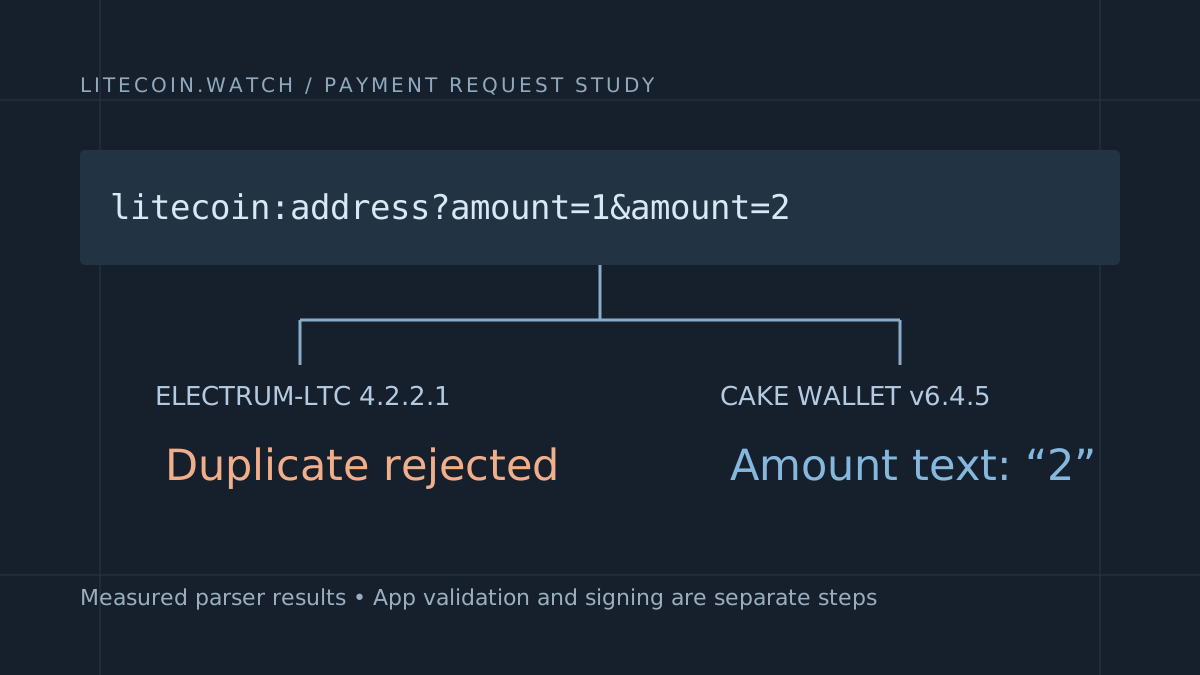
How two wallet parsers handle Litecoin payment requests
Twenty identical requests reveal differences in repeated amounts, decimal precision and metadata at the parsing boundary of Electrum-LTC and Cake Wallet. Exact versions, code and results are published.
Data / code included
What a Litecoin payment QR code actually tells your wallet
Twenty URI cases across two parsers, SVG scan examples and a practical checklist for Litecoin amounts, labels, address checks and invoice expiry.
Data / code included
Paying 50 people with Litecoin: one transaction or 50?
We signed 164 regtest candidates to measure Litecoin batching. See the savings with 1, 50 and 100 inputs, plus CSV data and reproducible Core tests.
Data / code included
Buying €100 of Litecoin: the costs between your bank and wallet
Nine public LTC/EUR order-book snapshots, a complete cost worksheet and four transparent scenarios for buying €100 or €1,000 and withdrawing Litecoin.
Data / code included
How small can a Litecoin payment be? Dust limits tested in Core
We tested 21 transaction candidates in Litecoin Core. Native SegWit passed at 2,940 litoshis; legacy needed 5,460. A tenfold fee increase did not fix dust.
Data / code included
Why a restored Litecoin wallet can show zero: three controlled tests
We tested missing history, an imported key absent from an older backup, and an Electrum address beyond the initial range. Inspect the balances, exact versions and reproduction scripts.
Data / code included
Can you recover your Litecoin wallet? Tested backups, seeds and account keys
We restored an encrypted Core wallet, Electrum seeds and BIP39-derived account keys. The tests separate matching addresses, finding funds and recovering signing authority.
Data / code included
New Litecoin.watch tools for checking and reconciling payments
Follow transaction outputs, reconcile invoice CSVs and inspect our new confirmation observer. A worked example shows why a matching amount can still need attention.

What actually happens when you send Litecoin
We signed 15 Litecoin transactions and replayed a real regtest reorganization. Inspect change, fees, input sizes and conflicting node views, with raw data and reproducible code.
Data / code included
Handling Litecoin payment refunds and underpayments
Resolve short, excess and late LTC payments. Compare refund policies with six calculations, a partial-refund example and downloadable workflow templates.
Data / code included