52.88 $
-1.97% -1.06 $
52.88 $
-1.97% -1.06 $
52.88 $
-1.97% -1.06 $
52.88 $
-1.97% -1.06 $

Core 0.21.5.8 strengthens MWEB validation, relay, mining and resource handling. We examine the code, explain the already-passed activation height and provide an operator checklist.
Research cutoff: September 14, 2026, 22:40 UTC. Hero image: AI-generated editorial illustration. The diagram below describes software behavior; it is not a performance measurement.
Litecoin Core 0.21.5.8 makes the handling of MWEB data more consistent across validation, storage, relay and mining. For operators, the central question is practical: does the node validate the exact extension data it is about to apply, including when that data comes back from disk? Several changes in this release tighten that boundary and make malformed alternatives less likely to interfere with valid traffic.
The official release was published on September 12, 2026 at 12:06 UTC. The maintainers strongly recommend upgrading, especially for mining pools, exchanges and services using MWEB. It incorporates the earlier 0.21.5.7 changes, which were distributed privately to mining pools. Those facts establish the release's operational importance; they do not, by themselves, establish a new incident, a loss of funds or a price catalyst. Source: official release.
| Item | Verified detail | How to use it |
|---|---|---|
| Public release | Litecoin Core 0.21.5.8; September 12, 2026. | Check the running daemon, not just the downloaded installer. |
| Included predecessor | 0.21.5.7 was a limited mining-pool distribution. | A public release history can omit an operationally significant intermediate version. |
| Consensus boundary | Empty signaled kernel extra data is rejected from mainnet height 3,172,640. | Height is authoritative; an estimated calendar date is not. |
| Observed network height | 3,177,984 at the research snapshot. | The activation height was already behind the observed tip. |
| Scope of this article | Release notes, selected code changes and operational interpretation. | This is not an independent audit of binaries or a reproduction of the upstream test suite. |
On a small screen, scroll the table horizontally.
Sources: release metadata and notes; final activation parameter; Litecoin Space tip endpoint, observed September 14 at 22:39 UTC. The endpoint is live and will now show a later height.
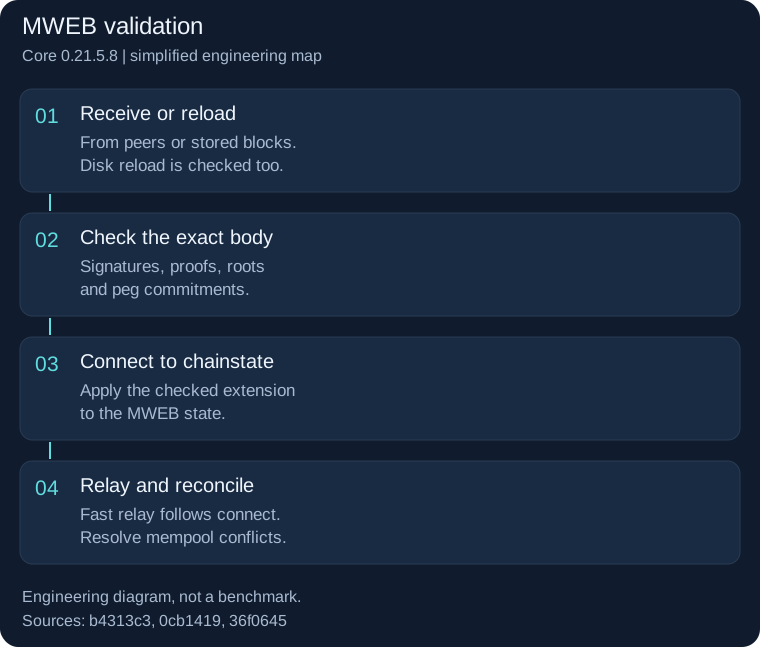
A block's identity and the complete data a node receives are related, but they are not interchangeable. The relay change explicitly documents that the MWEB body is not committed by the ordinary block hash. That means an implementation must be careful about treating a previously seen hash as proof that every attached representation has already passed the necessary checks. The relevant code now defers the MWEB fast-relay signal until the particular body has connected, and serializes block storage and activation. Source: relay and activation change.
The separate disk-reparse fix adds contextual checking inside the MWEB connection path. Its accompanying tests cover altered extension data after a block has been stored and loaded again. In the final patch, the object checked at connection is the object being applied to the MWEB state. Source: disk-reparse validation fix.
Our interpretation is that this is an important engineering boundary, not merely another check on a newly arriving network message. A live node also revisits stored data. A design that validates only the initial arrival would leave a different path for reloads. Bringing validation closer to the state change reduces reliance on assumptions about what happened earlier in the object's life.

Read the diagram as a conceptual map, not a literal listing of every function call. Other consensus checks, chain selection, disk operations and notification handlers still exist around these stages. It also does not imply that all ordinary Litecoin blocks now use exactly the same fast-relay sequence as MWEB-bearing blocks.
There are two different cases to keep separate: a kernel without the extra-data feature, and a kernel that signals the feature but supplies an empty payload. The new rule targets the second case. The first implementation introduced the check with a mainnet height of 3,200,000; a later change set the release's value to 3,172,640. Quoting the earlier commit alone would therefore give readers the wrong activation boundary. Initial rule; final height adjustment.
The final rule narrows the set of acceptable encodings, which is why the release describes this part as a soft fork. According to the maintainers, correctly operating wallets and miners do not create the empty signaled encoding. A software upgrade can still be important even if an ordinary user's transaction workflow looks unchanged. Source: consensus-change explanation.
At our snapshot the observed tip was beyond the activation height. An operator reading this article should therefore treat the boundary as historical, not wait for a future countdown. This height comparison does not measure how many nodes have upgraded, how much hash rate uses a particular version, or whether every service has completed its rollout. Those are separate questions requiring separate evidence.
The same-hash handling patch distinguishes problematic MWEB representations and adds a kernel-root validation helper. The operational objective is to avoid turning the rejection of an invalid body into a blanket refusal to process a valid counterpart associated with the same block identity. Source: same-hash mutation handling.
A related change concerns the recent-rejection cache for transactions. The code identifies transactions whose conventional identifiers can refer to different MWEB relay payloads, including a peg-in with required extension data removed. Caching a rejection solely against a shared identifier would be too broad in that situation. Source: transaction rejection-cache change.
These are different layers of the same general design problem: remember enough about bad input to limit repeated work, while retaining the ability to accept good input. A cache is an optimization and a traffic-control mechanism; it should not silently become a broader consensus rule. That is our interpretation of the relationship between these changes, rather than a claim that all denial-of-service cases have been eliminated.
| Area | Change in the source | Operational implication |
|---|---|---|
| Block construction | Incremental aggregate validation retains validated sum state as transactions are added. | Review template construction under representative MWEB traffic; do not assume a measured speedup. |
| Mempool conflicts | Conflict reconciliation examines mined kernels, spent inputs and surviving outputs. | Monitor pending transactions after a block connects; an entry disappearing need not mean a wallet payment disappeared. |
| Invalid range proofs | Scratch-frame cleanup is added on malformed-point exits. | Failure paths should release temporary verification resources. |
| POSIX file copying | Descriptor guards correctly close input and output handles. | Repeated copying and failed copies should not steadily consume file descriptors. |
| Undo metadata | The peg-out flag is serialized in transaction undo data. | Restoring prior state must preserve the relevant output metadata. |
| Queued script checks | Precomputed data outlives the queue controller. | Early returns must not destroy data still used by pending checks. |
| Legacy RPC clients | MWEB-only mempool entries cannot be serialized by incompatible legacy RPC modes. | Test the specific RPC methods and serialization settings used by your integration. |
On a small screen, scroll the table horizontally.
The aggregate change is particularly relevant to miners. Adding a candidate transaction is not simply appending bytes: the combined extension must remain internally consistent. The implementation carries forward validated sums and checks additions, including incompatible combinations and duplicate kernels. This can avoid repeatedly rebuilding and validating the entire accumulated body. We have not benchmarked template latency, CPU use or throughput, so a percentage improvement would be unsupported. Source: aggregate validators and tests.
Mempool reconciliation deserves similar care. A pool of pending transactions is not a permanent ledger. When a block spends inputs or contains kernels also present in an aggregate, the node must distinguish what was mined, what conflicts, and which remaining outputs can still support descendants. The patch's tests exercise these distinctions. For an operator, the useful question is whether the pending set remains coherent after new blocks, rather than whether its raw entry count only rises. Source: mempool implementation and tests.
Resource cleanup changes can look small in a diff while affecting long-running processes. A resource retained on a rejected proof or unsuccessful copy can accumulate across repeated failures. The linked changes add checks around such paths. That supports a robustness rationale; it does not supply a measured attack cost or a guarantee that resource consumption is bounded in every other part of the daemon.
The following is an editorial rollout checklist, not a claim that we upgraded or tested your node. Use the official release assets and your organization's normal backup, change-control and recovery procedures. Keep wallet backups and recovery information private. A node software update is not a reason to submit a seed phrase to a website or support account.
| Role | Before rollout | After restart |
|---|---|---|
| Personal Core user | Back up wallet material using the wallet's supported procedure. Obtain the correct package through the official release. | Verify the running version, synchronization and expected wallet state before relying on it. |
| Full-node operator | Record the current version, tip, configuration and recovery procedure. Shut down cleanly. | Check logs, connected peers, advancing block height and agreement with an independent reference. |
| Mining pool | Exercise template generation and submission in a controlled environment with representative MWEB cases. | Watch template errors, rejected submissions and consistency among backend nodes. |
| Exchange or payment service | Test the actual RPC consumer, including its handling of MWEB-only entries and unavailable representations. | Reconcile deposit detection, confirmations and withdrawal monitoring across your own systems. |
| Explorer or indexer | Preserve a recovery point and test restart/replay behavior using your own indexer. | Check that derived state follows the node and that pending entries reconcile after blocks. |
On a small screen, scroll the table horizontally.
A downloaded file and a running process are different things. Services can point to an older executable, a container can retain an old image, and a machine can run more than one daemon. Record the version reported by the process providing your production RPC endpoint. Compare its tip with an independent reference and investigate discrepancies rather than treating a single successful RPC response as proof of a healthy rollout.
For staged infrastructure, define the acceptance criteria before replacing every backend. Examples include an advancing tip, expected peers, no new recurring validation errors, and successful reads by the production application's RPC client. Preserve logs around the change so an application regression can be distinguished from a synchronization delay. Do not improvise a downgrade of chainstate or wallet files without checking compatibility and your recovery plan.
The reviewed material does not quantify ecosystem upgrade adoption, exchange withdrawal availability, or a return on holding LTC. It also does not establish that every issue described was exploited. A maintenance release can contain consensus, reliability and integration changes at the same time; collapsing them into one headline about a “hack” or a “performance boost” would lose the distinctions that operators need.
For readers following the market, network maintenance and macroeconomic conditions should be evaluated independently. Our companion article, Litecoin Ahead of the September Fed Decision: What to Watch, examines observed prices and conditional policy scenarios without attributing a market move to this release.
The reviewed release describes a Core software update, not a token swap. Users of a hosted service depend on that service's backend rollout; users running Core manage their own installation. Follow the official software instructions and never treat an unsolicited migration link as part of this article.
No. The release uses mainnet height 3,172,640, and the network tip observed for this article was higher. This statement concerns the activation boundary, not the proportion of operators already upgraded.
No such guarantee follows from these changes. Incremental aggregate validation is an engineering improvement, but this article supplies no independent benchmark. The release also does not determine demand for LTC or future market prices.
We checked the official GitHub release metadata, compared selected implementation and test diffs, and recorded a network-height snapshot. Each technical subsection links the relevant primary source. We did not execute the full upstream tests, audit release binaries or estimate network-wide adoption. The diagram is an original explanatory schematic. Operational implications and the rollout checklist are editorial analysis, separated from the maintainers' stated changes.
Start with the official 0.21.5.8 release and assets. For consensus timing, read the final parameter change as well as the original rule introduction. For integration behavior, read the linked method and test changes rather than relying on the version number alone.